What are the best types of trading?
The best types of trading are day trading, swing trading, scalping, momentum trading, technical trading, fundamental trading, and the mixed approach. Each style differs by time horizon, analysis method, and market fit — scalping suits high-liquidity markets and fast execution, swing trading suits part-time traders looking for multi-day moves, and the mixed approach combines multiple methods for more experienced traders. The right type depends on your available time, risk tolerance, and the assets you trade.
Trading comes in many forms. The approach that works for a full-time professional differs significantly from what works for someone who reviews charts once a week. Understanding the main trading styles before you commit capital can save you from applying the wrong method to the wrong market — or the wrong market to the wrong schedule.
This guide covers 7 major types of trading: how each works, what it demands in time and skill, and which asset classes it tends to suit best.
What makes trading styles different from each other?
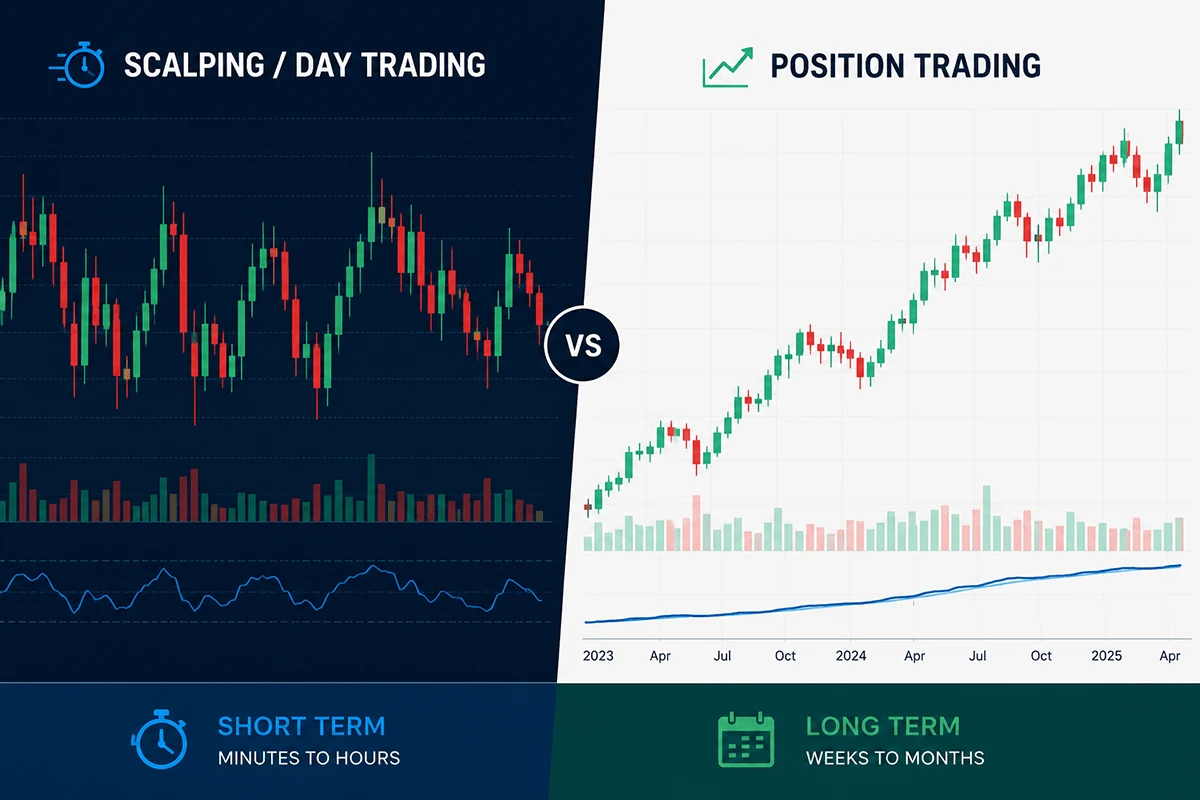
Trading styles differ across three key dimensions:
- Time horizon — how long you hold a position, from seconds to years
- Analysis method — whether decisions rely on charts, economic data, algorithms, or a combination
- Asset focus — some styles suit high-liquidity currency pairs; others work better in commodities or equities
There is no universally "best" style. The right choice depends on your available time, risk tolerance, capital, and analytical strengths.
1. Day trading
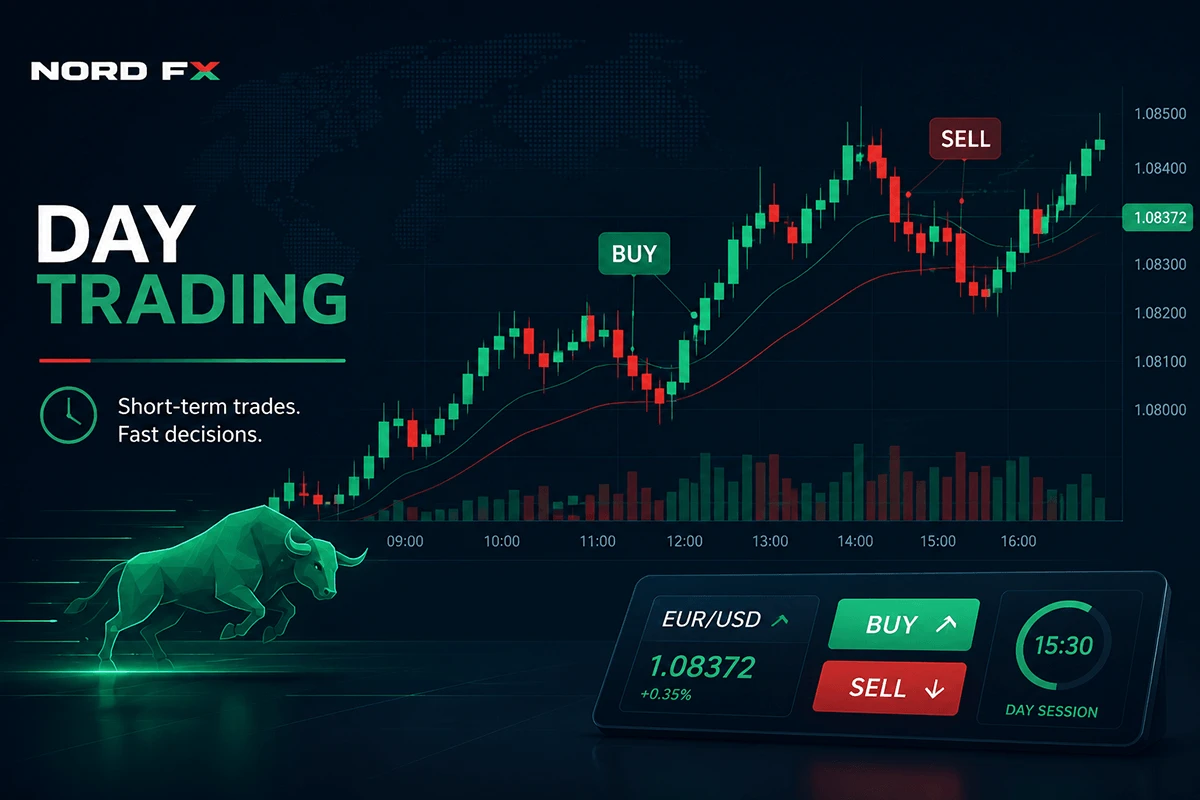
Day traders open and close all positions within a single trading session. No trade carries overnight.
How it works: Day traders target short-term price movements driven by news, technical breakouts, or volume spikes. Entries and exits happen within hours. By end of session, the slate is clean.
Time commitment: High. Active market monitoring throughout the session is standard practice.
Best suited for: High-liquidity markets — currency pairs, gold, major indices, oil. Markets that move consistently within a defined session window.
What you need: A solid grasp of technical analysis, strict risk controls per trade, and the discipline to close positions without hesitation when they hit a stop.
Key risk: Overtrading. The constant availability of signals can encourage poor trade selection. More trades does not mean more edge.
2. Swing trading
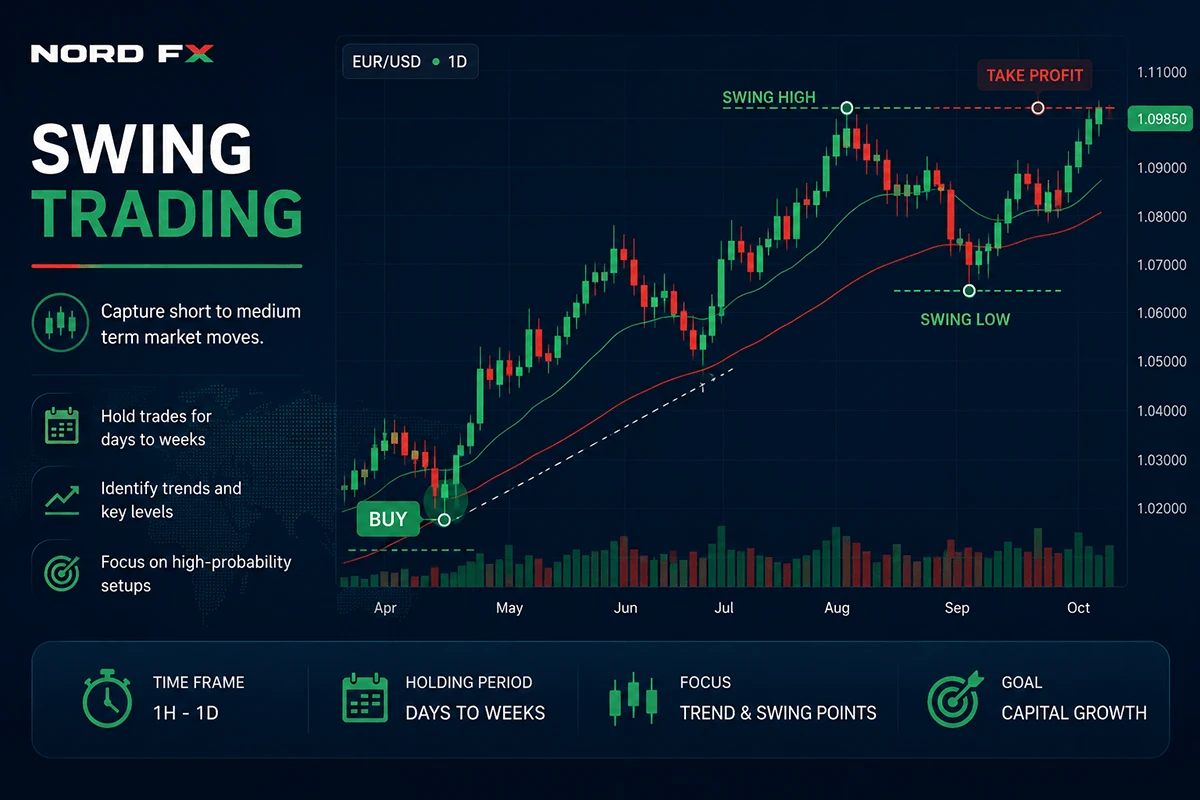
Swing traders hold positions for several days to a few weeks. The goal is to capture the price "swing" between a trend's pullback and its continuation.
How it works: Traders identify the prevailing trend, wait for a temporary reversal (the pullback), then enter in the direction of the trend before price resumes. RSI, moving averages, candlestick patterns, and support/resistance levels are commonly used for timing.
Time commitment: Moderate. Reviewing charts once or twice per day is usually sufficient.
Best suited for: Gold, oil, stocks, and crypto — markets that show directional behavior over multi-day periods.
What you need: Patience to let trades develop over days and the discipline not to exit early on minor counter-moves.
Key risk: Overnight exposure. Holding through weekends or major news events can result in gaps against your position.
3. Scalping
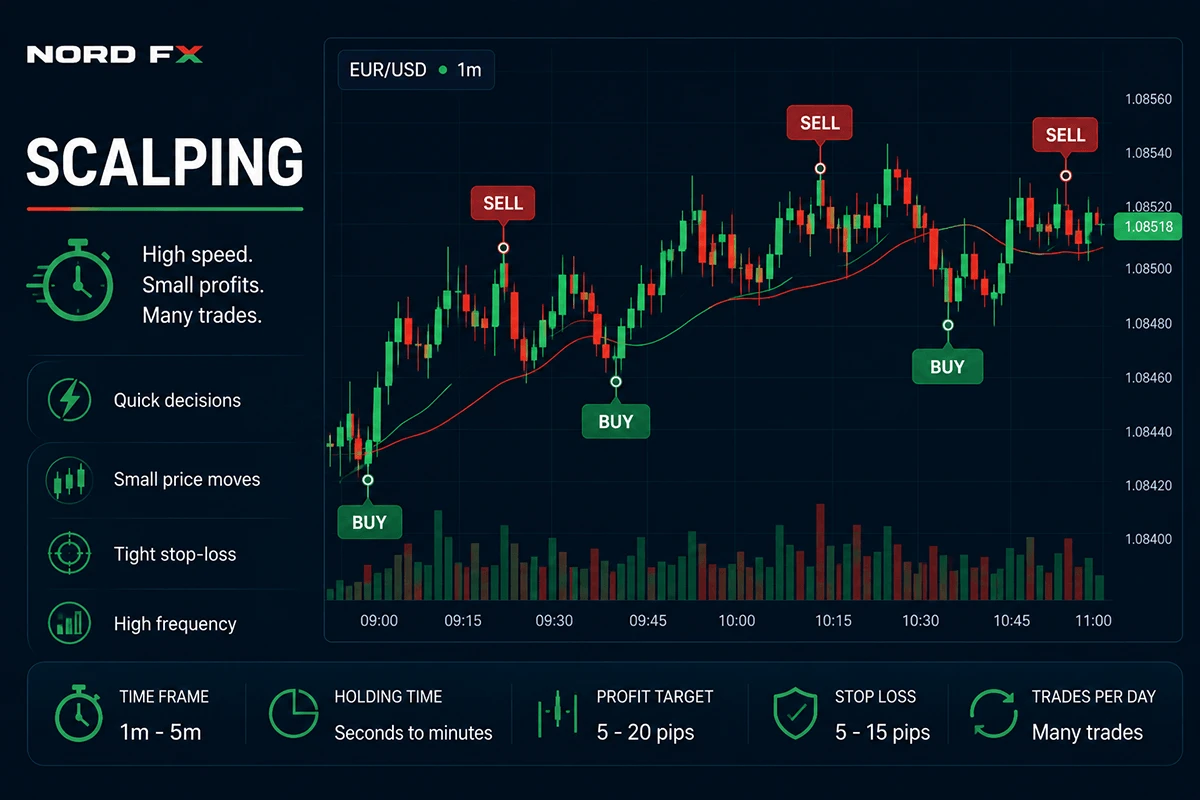
Scalpers profit from very small price movements by placing a large number of trades — sometimes dozens or hundreds per session.
How it works: Entry and exit happen within minutes or seconds. The profit per trade is tiny; volume makes it accumulate. Execution speed and tight spreads are critical. Scalpers focus on the most liquid markets where the bid-ask spread is narrow and fills are reliable.
Time commitment: Extremely high. This is a full-time, screen-intensive activity.
Best suited for: Major currency pairs, gold, and liquid indices where spreads are tight and order execution is fast. MT4 and MT5 both provide the execution environment scalpers require.
What you need: Fast execution conditions, low spreads, strict daily loss limits, and the psychological ability to take frequent small losses without breaking discipline.
Key risk: Costs. Commissions and spreads erode profits quickly if trading conditions are not favorable. Know your total cost per round-trip before scalping any instrument.
4. Momentum trading
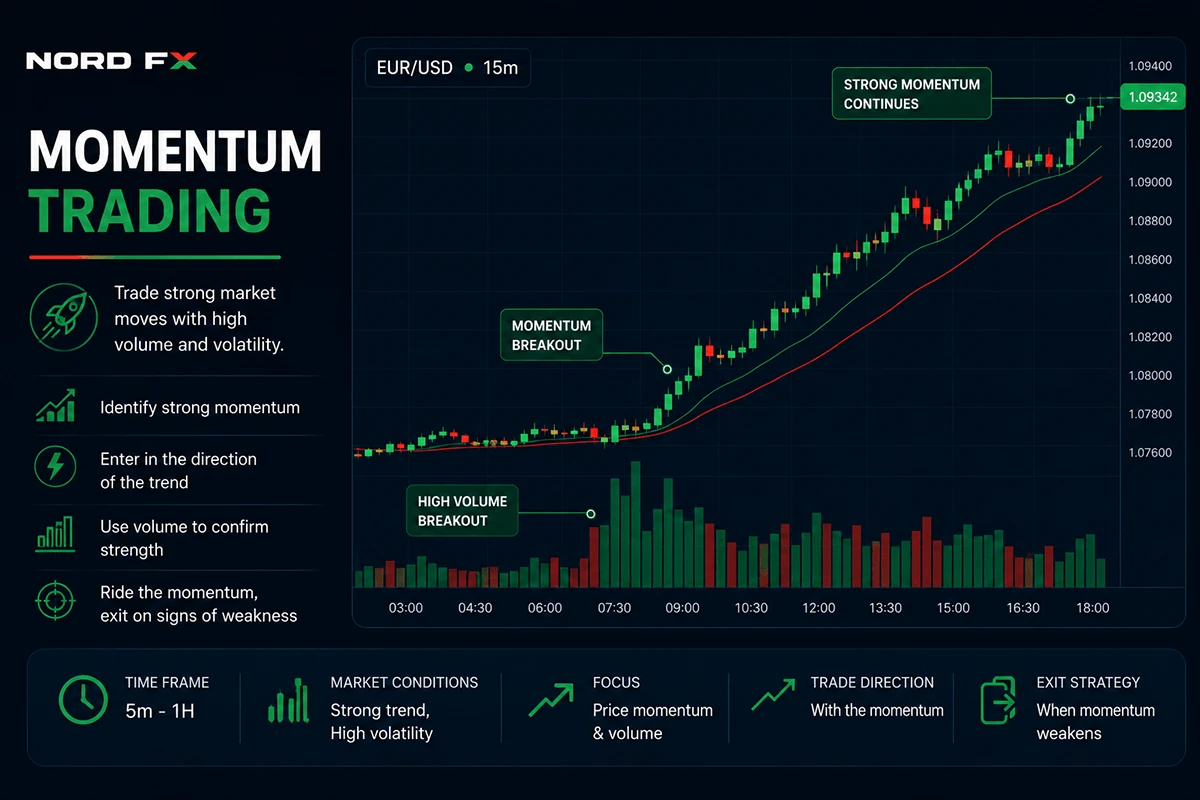
Momentum traders enter assets already moving strongly in one direction and exit when that momentum shows signs of exhaustion.
How it works: The strategy is based on the observation that assets trending strongly tend to continue in the same direction — at least for a period. Traders look for breakouts to new highs or lows, accompanied by high volume, as entry confirmation. The entry is with the move, not against it.
Time commitment: Moderate to high. Momentum can shift quickly, particularly in volatile markets like crypto.
Best suited for: Stocks, crypto, and commodities where catalysts — earnings reports, regulatory news, commodity supply shocks — trigger sharp, sustained directional moves.
What you need: Fast screening to find the right assets at the right moment, clear exit criteria for when momentum fades, and the discipline to not chase entries that have already extended too far.
Key risk: Late entries. Entering a trend that is near exhaustion — buying the spike rather than the breakout — is the most common momentum trading mistake.
5. Technical trading
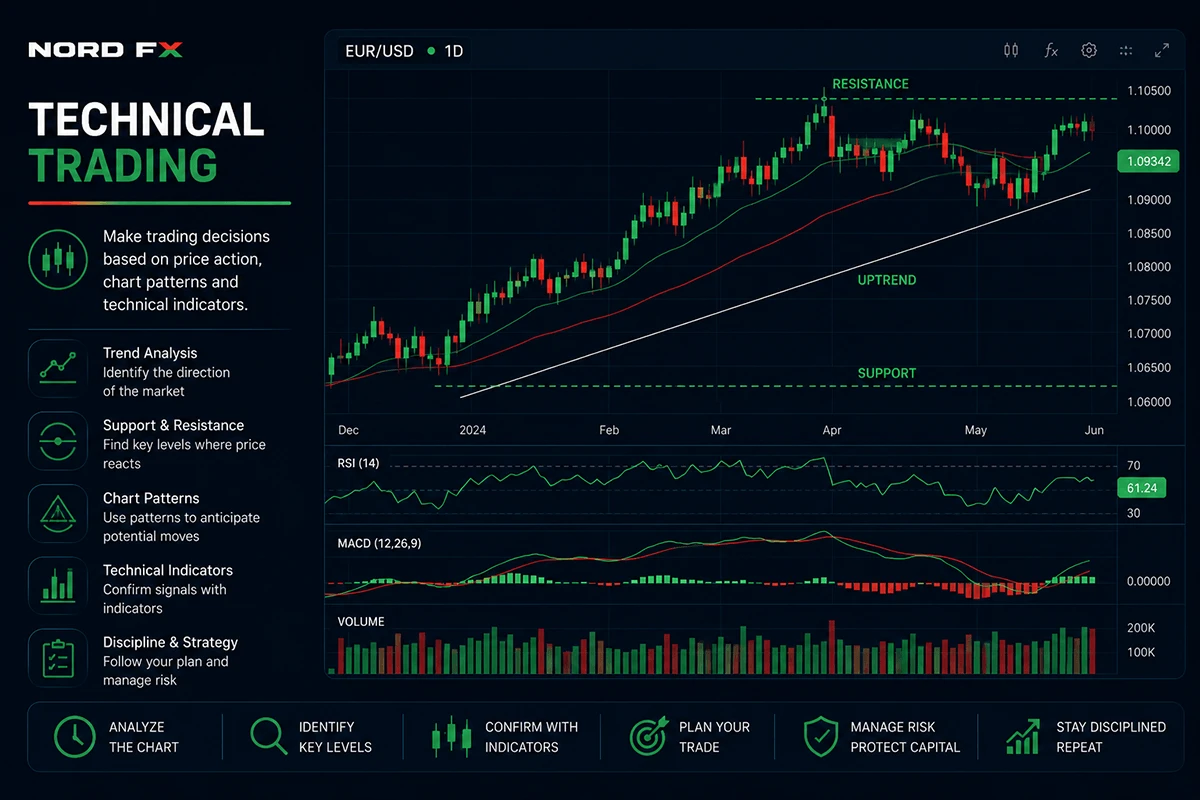
Technical traders make all decisions based on price charts and statistical indicators. Fundamentals are secondary or irrelevant; only price action and volume matter.
How it works: Charts are analyzed for patterns (head and shoulders, flags, triangles), key support and resistance zones, and signals from indicators such as MACD, Bollinger Bands, RSI, Stochastic, and moving average crossovers. The assumption is that all available information is already reflected in the price.
Time commitment: Flexible. Technical analysis applies to any timeframe — from 1-minute scalping charts to weekly position trading charts.
Best suited for: Any tradeable asset. Technical analysis works on currency pairs, gold, crypto, oil, indices, and stocks. It is the most universally applied analytical approach.
What you need: Familiarity with charting tools and the time to practice pattern recognition. MT4 and MT5 both offer extensive built-in indicators and custom charting. Hundreds of additional indicators are available through MQL4/MQL5 libraries.
Key risk: Indicator overload. Using too many indicators creates conflicting signals and indecision. Most experienced technical traders use a small number of tools consistently rather than cycling through different setups.
6. Fundamental trading
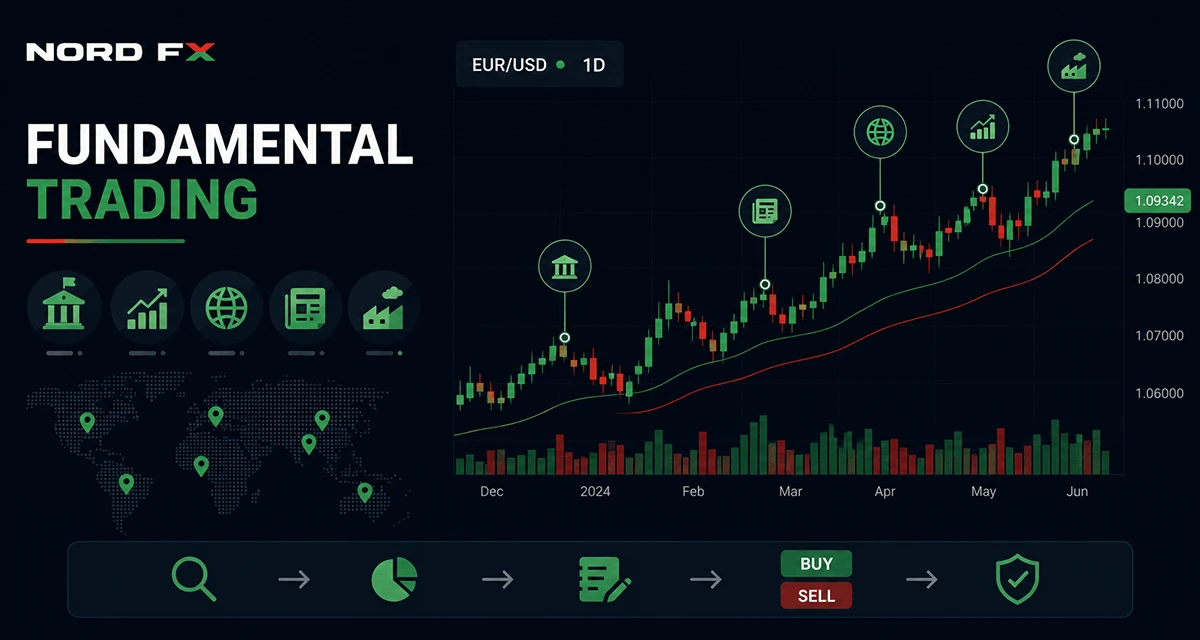
Fundamental traders analyze the underlying economic or financial data that drives an asset's intrinsic value, rather than reading price charts.
How it works: For currency pairs, this means tracking central bank interest rate decisions, inflation prints, GDP growth, and employment data. For commodities like gold and oil, it means following supply and demand dynamics, inventory reports, geopolitical events, and seasonal trends. For stocks, it is earnings, revenue growth, margins, and balance sheet health.
Time commitment: Variable. Fundamental traders often hold positions longer — waiting for a catalyst to materialize or for the market to price in new data. Research time is significant.
Best suited for: Gold, oil, major currency pairs, and stocks — markets where macro or micro fundamentals have a clear, demonstrable effect on price over time.
What you need: The ability to read and interpret economic calendars, central bank statements, OPEC reports, earnings releases, and macroeconomic indicators.
Key risk: Timing. The fundamental analysis can be correct while price moves against you for weeks before the market catches up. Without a stop loss, a right thesis at the wrong time is still a losing trade.
7. Mixed / combined approach
Most experienced traders do not use a single style exclusively. They combine elements from multiple approaches — applying different methods at different stages of the trade decision. This is sometimes called confluence trading.
How it works: A common example: use fundamental analysis to determine which asset to trade and in which direction; use technical analysis to determine when to enter; use momentum signals to confirm that the move has started. Swing and position timeframes can also coexist — holding a longer-term position while trading shorter-term setups within it.
Time commitment: Depends on the combination of styles used.
Best suited for: Traders with experience across multiple approaches who understand when each type of analysis is most relevant. Multi-asset brokers like NordFX make it easier to apply different styles across different markets — currency pairs, gold, crypto, oil, and stocks — all from a single MT4 or MT5 account.
What you need: A clear, written trading plan that defines which inputs take priority when they conflict. Without a hierarchy, multiple signals create paralysis rather than better decisions.
Key risk: Analysis paralysis. The more inputs you use, the more potential for conflicting signals. The goal of combining approaches is to reduce uncertainty, not increase it. If your setup requires five conditions to align, you may never trade.
Comparison: which trading style fits your situation?
Style | Typical hold time | Daily time needed | Common markets |
Scalping | Seconds – minutes | Very high | Currency pairs, gold, indices |
Day trading | Minutes – hours (intraday) | High | Currency pairs, gold, oil, indices |
Momentum | Hours – days | Moderate – high | Crypto, stocks, commodities |
Swing | Days – weeks | Moderate | Gold, oil, stocks, currency pairs |
Technical | Any timeframe | Varies | All asset classes |
Fundamental | Days – months | Varies (research-heavy) | Currencies, gold, oil, stocks |
Mixed / combined | Varies | Varies | All asset classes |
Which assets suit which trading styles?
The trading style you choose should match the market you trade. Here is how the main approaches map to asset classes:
- Currency pairs — work across all styles. Tight spreads, high liquidity, and 24-hour availability make currency markets suitable for scalping, day trading, technical trading, fundamental trading, and algorithmic strategies.
- Gold — suits position, swing, fundamental, and technical trading. Gold is macro-driven, reacts to central bank policy and geopolitical risk, and shows strong trend behavior over extended periods.
- Crypto — popular for momentum and swing trading. High volatility and 24/7 market hours create opportunities but also require stricter risk management than traditional markets.
- Oil — suits fundamental and position traders. Supply/demand cycles, OPEC decisions, and seasonal patterns drive multi-week and multi-month trends.
- Stocks and indices — popular for fundamental, momentum, and swing trading. Earnings cycles and macroeconomic shifts create regular tradeable events.
NordFX gives access to all these asset classes through MT4 and MT5, meaning you can apply any of the trading styles above across different markets from a single account — without switching brokers or platforms.
Common mistakes in trading
- Choosing a style that doesn't fit your schedule. Scalping and day trading require hours of active screen time. Starting with these when you have a full-time job leads to missed entries, emotional decisions, and losses driven by distraction rather than the market.
- Switching styles too quickly. Traders abandon a style after a few losing trades before giving it enough time to prove itself. Every style has drawdown periods. Switching mid-streak compounds losses instead of stopping them.
- Using too many indicators. More inputs do not mean better analysis. Conflicting signals create paralysis. Most experienced traders use 2–3 indicators consistently rather than cycling through new setups.
- Ignoring the time horizon of your analysis. Using a daily chart signal to enter a 5-minute scalp — or vice versa — puts your timeframes in conflict. Analysis and execution must match.
- Skipping risk management. No trading style works without defined stop losses and position sizing. A good entry without a stop is just an open-ended risk.
- Treating the mixed approach as a beginner strategy. Combining styles requires understanding each one individually first. Beginners who try to use everything at once end up with no clear edge and no clear rules.
- Confusing paper trading performance with live trading. Strategies tested on demo accounts or historical data almost always perform worse live. Slippage, spreads, and psychology change the outcome.
FAQ
What type of trading is best for beginners?
Swing trading is commonly recommended as a starting point. It does not require constant screen monitoring, gives time to think through each decision, and allows basic technical analysis to be applied without the time pressure of intraday trading. Position trading is another option for those with a fundamental background.
Can I combine more than one trading style?
Yes, and many experienced traders do. A common combination is using fundamental analysis to select the asset and direction, and technical analysis to time the entry. This is the mixed/confluence approach described above. The key is to have clear rules about which signals take priority when they conflict.
How much capital do I need to start trading?
It depends on the style and the broker. Scalping typically requires larger capital to generate meaningful returns on very small moves. Swing and position trading can be started with less. Many brokers, including NordFX, offer leverage, which changes the capital requirement — but leverage amplifies losses as well as potential gains, so risk management is essential.
Is day trading more profitable than swing trading?
Neither is objectively better. Day trading eliminates overnight risk but demands more time, faster decisions, and generates more emotional pressure. Swing trading involves overnight exposure but is less time-intensive and allows more considered analysis. Profitability depends on the trader's execution, discipline, and fit with the style — not the style itself.
Do these trading styles work across all financial markets?
Most styles can be applied across different asset classes, but some are better matched to specific markets. Scalping requires high liquidity and tight spreads — it works best in major currency pairs or gold. Fundamental trading is most relevant in markets where economic data demonstrably drives price. Technical trading is the most universally applicable, working across all timeframes and asset classes.
What trading platforms support these styles?
MT4 and MT5 are the industry-standard platforms that support all the styles covered in this guide — charting and technical indicators for technical trading, economic calendars for fundamental analysis, Expert Advisors for algorithmic trading, and the execution speed required for scalping and day trading.
Meet the Author
Vanessa Polson is a marketing manager at NordFX with over twelve years of experience in online marketing within the financial services industry. She has developed and executed data-driven campaigns across search, social, and display channels in in-house environments. Her work focuses on translating complex financial products and trading tools into clear, practical educational content, giving her a broad and well-rounded view of the global trading landscape.
Connect with Vanessa on LinkedIn.
Voltar Voltar