What is currency strength meter?
Quick answer: A currency strength meter is a forex analysis tool that measures the relative strength or weakness of currencies by analyzing multiple currency pairs and economic conditions. Traders use it to identify trending currencies, avoid weak market conditions, and improve trade selection.
A currency strength meter helps traders compare the relative strength and weakness of currencies using price action, economic data, or both. It simplifies market analysis by showing which currencies are gaining momentum and which are losing strength, helping traders identify potential trading opportunities faster.
Forex traders often struggle with one challenge: choosing the right currency pair at the right time. Even with technical indicators and chart analysis, it can be difficult to determine whether a move is driven by genuine market strength or short-term volatility. A currency strength meter aims to solve that problem by measuring how strong or weak each major currency is relative to others.
Key Takeaways
- A currency strength meter compares currencies against each other to identify strong and weak trends.
- Traders often buy strong currencies and sell weak currencies to align with market momentum.
- Some currency strength meters use technical analysis, while others include macroeconomic data.
- Strong-versus-weak currency combinations typically produce clearer trends than balanced pairs.
- Currency strength tools work best when combined with risk management and chart analysis.
What Is a Currency Strength Meter?
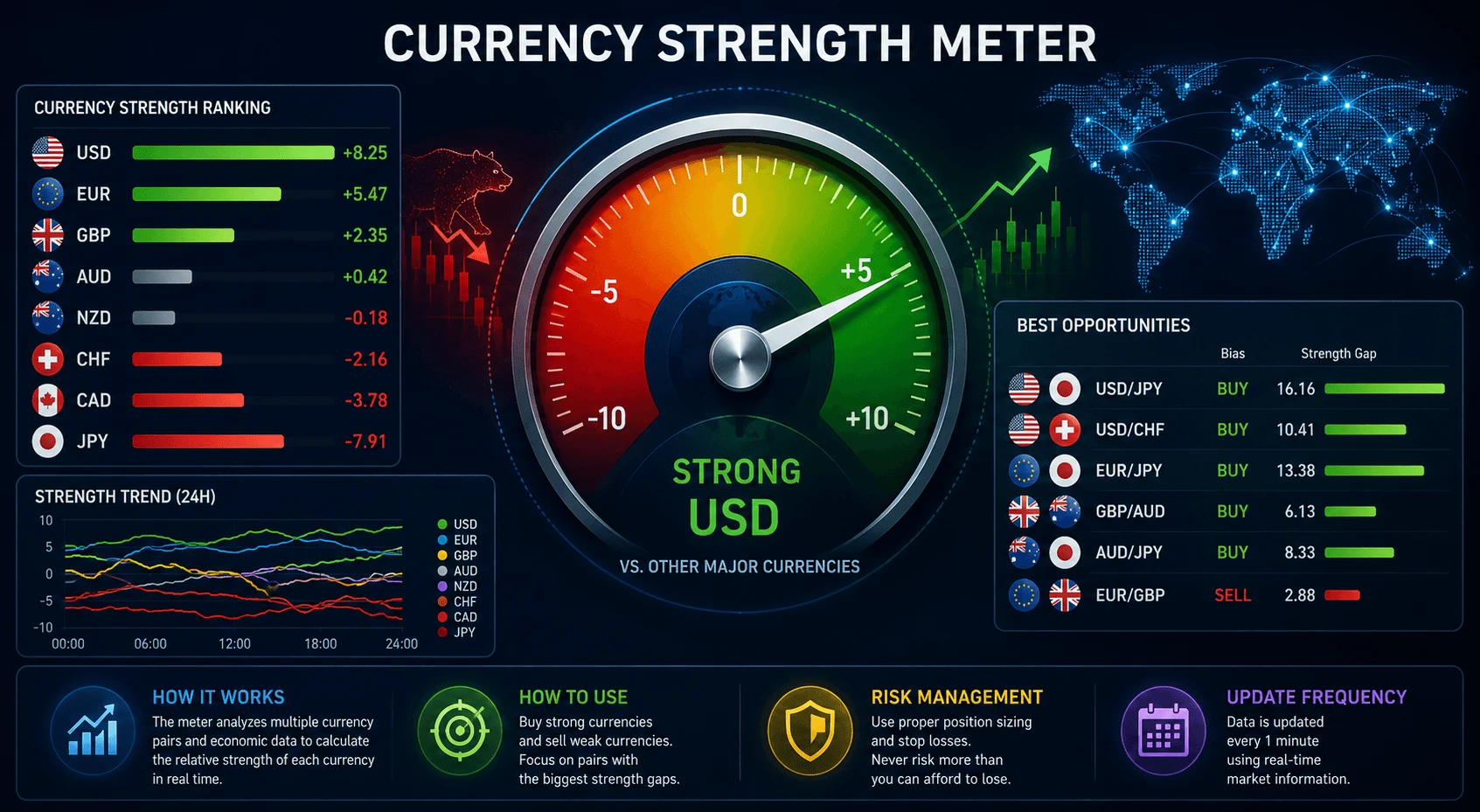
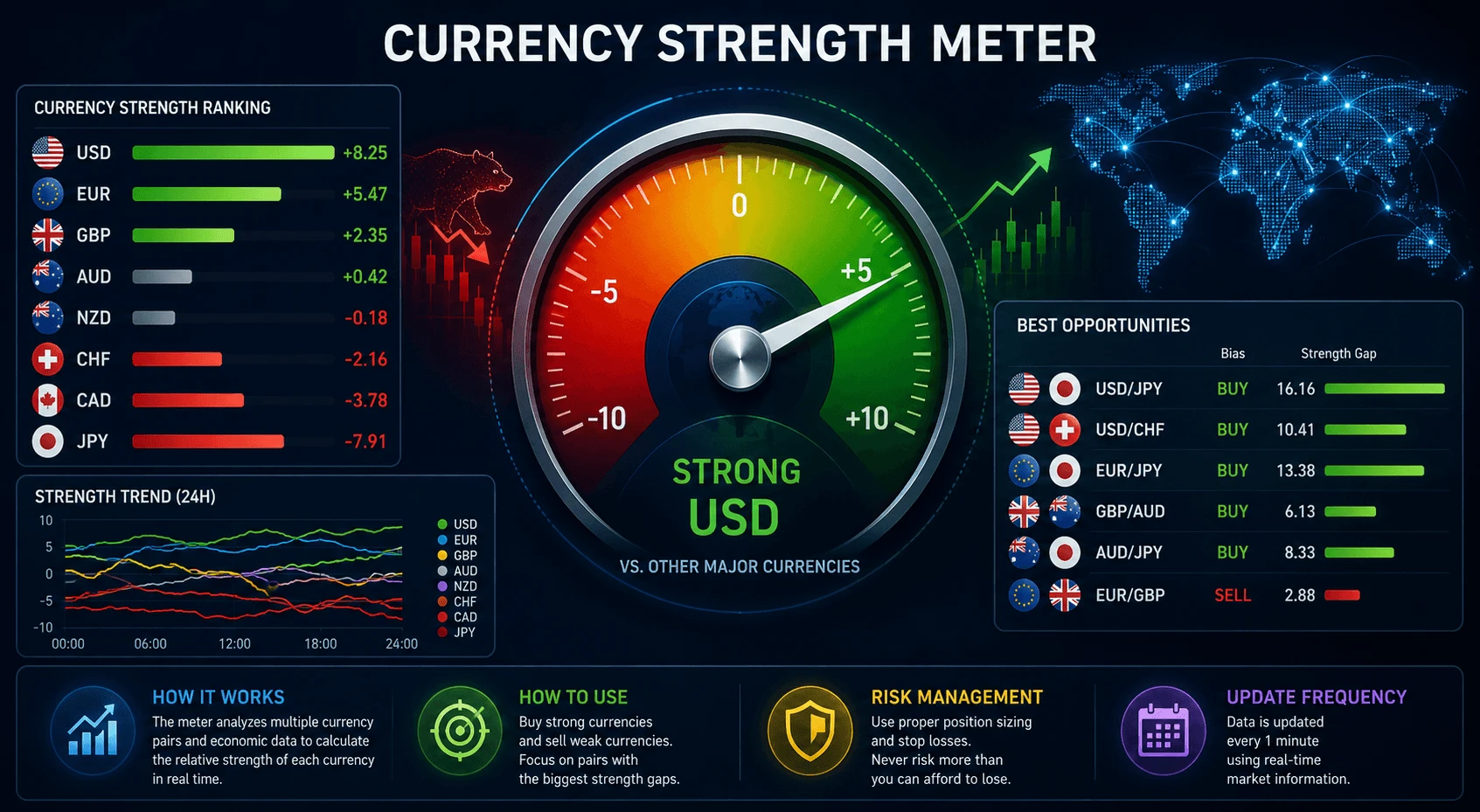
A currency strength meter is a trading tool that measures the relative strength of currencies in the forex market. Instead of analyzing only one currency pair, the tool evaluates multiple pairs simultaneously and assigns a strength score to each currency.
For example, the US dollar appears in many major forex pairs, including EUR/USD, GBP/USD, USD/JPY, and USD/CHF. A currency strength meter analyzes how the dollar performs across these pairs to determine whether it is broadly strong or weak.
The main purpose of the tool is to help traders:
- Identify trending currencies
- Compare relative strength between currencies
- Avoid low-momentum market conditions
- Spot potential trade opportunities faster
Most meters display currencies using a numerical scale, color coding, or ranking system. Green often represents strong currencies, while red indicates weakness.
A currency strength meter is different from a currency index. An index such as the US Dollar Index measures the dollar against a weighted basket of currencies. A currency strength meter, by contrast, evaluates multiple forex pairs equally or through proprietary weighting systems to estimate overall market strength.
How Does a Currency Strength Meter Work?
A currency strength meter collects data from multiple currency pairs and calculates how strongly each currency is performing over a selected timeframe.
Most tools scan recent market activity across pairs such as:
Currency | Common Pairs Used |
USD | EUR/USD, GBP/USD, USD/JPY, USD/CHF |
EUR | EUR/USD, EUR/GBP, EUR/JPY |
GBP | GBP/USD, EUR/GBP, GBP/JPY |
JPY | USD/JPY, EUR/JPY, GBP/JPY |
The meter then measures price movement, momentum, or economic performance and converts that information into a score.
Technical Currency Strength Meters
Technical currency strength meters rely primarily on historical price action and market momentum.
They typically calculate:
- Percentage price changes
- Relative momentum
- Trend direction
- Volatility
- Moving average relationships
Suppose EUR/USD rises by 1.5% while GBP/USD rises only 0.3%. The meter may conclude that the euro is stronger than the pound relative to the US dollar.
These meters update frequently, often every minute, making them useful for short-term traders and day traders.
Fundamental Currency Strength Meters
Fundamental or macro currency strength meters use economic and financial data instead of price action alone.
These tools may analyze:
- GDP growth
- Inflation
- Interest rates
- Employment data
- Central bank policy
- Bond yields
- Trade balances
Instead of simply measuring recent movement, they attempt to estimate the underlying economic strength of a currency.
For example, a currency backed by rising interest rates, strong employment growth, and improving business activity may receive a strong fundamental ranking even before major price moves occur.
Real-Time Updates
Most modern currency strength meters refresh automatically using live forex market data.
A typical tool may:
- Scan all major pairs every minute
- Recalculate strength rankings
- Display changes visually
- Highlight strengthening or weakening trends
This allows traders to react quickly to changing market conditions.
How to Read a Currency Strength Meter
Learning how to interpret the readings is essential before using a currency strength meter in live trading.
Positive and Negative Scores
Many tools assign positive and negative values to currencies.
A positive score usually indicates:
- Strong momentum
- Bullish market sentiment
- Relative outperformance
A negative score generally signals:
- Weak momentum
- Bearish sentiment
- Relative underperformance
For example:
Currency | Score |
USD | +7 |
EUR | +5 |
GBP | -2 |
JPY | -6 |
In this scenario, traders may look for opportunities to buy USD or EUR against weaker currencies like JPY or GBP.
Color-Based Rankings
Many platforms use color coding for fast interpretation.
Color | Meaning |
Green | Strong |
Light Green | Moderately Strong |
Red | Weak |
Dark Red | Very Weak |
The visual format helps traders quickly identify market leadership without reviewing multiple charts.
Trend Direction
Some advanced meters also show whether a currency is strengthening or weakening over time.
For example:
- Upward arrows may indicate increasing strength
- Downward arrows may indicate weakening momentum
- Neutral signals suggest sideways conditions
Trend direction is important because a currency can still appear strong while losing momentum.
How Traders Use Currency Strength Meters
A currency strength meter is not a complete trading system by itself. Instead, traders use it as a market filter and directional guide.
Finding Strong vs Weak Currency Pairs
One of the most common strategies is pairing the strongest currency against the weakest currency.
For example:
- Strong USD + weak JPY = potential USD/JPY long trade
- Strong GBP + weak EUR = potential GBP/EUR long trade
This approach attempts to align with overall market momentum.
Avoiding Sideways Markets
If two currencies show similar strength readings, the market may lack clear direction.
For example:
Pair | Strength Relationship |
EUR/USD | Both moderate strength |
GBP/AUD | Strong GBP vs weak AUD |
USD/CAD | Both weak |
Traders often prefer pairs with larger strength gaps because they tend to produce cleaner trends.
Confirming Technical Analysis
Many traders combine currency strength readings with:
- Support and resistance
- Moving averages
- Breakout strategies
- Trendline analysis
- Candlestick patterns
For example, if a breakout occurs on GBP/USD while GBP strength is rising and USD strength is falling, the trade setup may carry stronger confirmation.
Intraday Trading
Day traders frequently use short-term currency strength meters to:
- Identify active sessions
- Find momentum opportunities
- Trade volatility spikes
- Track reactions to economic news
Because forex markets move quickly, real-time updates are particularly useful during London and New York sessions.
Currency Strength Meter Pricing Logic
Currency strength meters range from free browser tools to advanced institutional-grade platforms costing hundreds per month.
The pricing difference usually depends on:
Feature | Free Tools | Premium Tools |
Real-time updates | Limited | Yes |
Technical analysis | Yes | Yes |
Fundamental analysis | Rare | Common |
Customization | Basic | Advanced |
Historical tracking | Limited | Extensive |
Economic integration | Minimal | Detailed |
Free Currency Strength Meters
Free tools are widely available and typically rely on technical calculations based on price action.
These tools are suitable for:
- Beginners
- Basic trend analysis
- Short-term momentum trading
- Learning market relationships
However, free tools may suffer from:
- Delayed updates
- Simplified calculations
- Limited transparency
- Fewer customization options
Premium Currency Strength Meters
Premium solutions often combine technical and macroeconomic analysis.
They may include:
- Economic scoring systems
- AI-assisted analysis
- Institutional data feeds
- Historical strength comparisons
- Automated alerts
These tools are more commonly used by:
- Professional traders
- Swing traders
- Macro traders
- Multi-asset traders
The higher cost reflects the complexity of the data processing involved.
Technical vs Fundamental Currency Strength Meters
Choosing between technical and fundamental currency strength meters depends on trading style and goals.
Technical Currency Strength Meters
Technical tools focus on market behavior.
Best suited for:
- Scalping
- Day trading
- Short-term trend trading
- Momentum strategies
Advantages include:
- Fast updates
- Simple interpretation
- Real-time responsiveness
Limitations include:
- Less focus on economic drivers
- Greater sensitivity to short-term volatility
Fundamental Currency Strength Meters
Fundamental tools focus on economic strength and macro trends.
Best suited for:
- Swing trading
- Position trading
- Macro investing
- Long-term trend analysis
Advantages include:
- Broader economic perspective
- Better context for long-term trends
- Less dependence on short-term price noise
Limitations include:
- Slower reaction time
- More complex interpretation
- Higher data requirements
Which Is Better?
Neither approach is universally better.
A short-term trader may prefer technical strength analysis because speed matters more than macro context. A long-term trader may prefer fundamental analysis because economic conditions drive broader currency trends over time.
Some advanced traders combine both methods to gain a more balanced market view.
How Currency Strength Is Calculated
Different platforms use different formulas, but most calculations follow a similar principle.
Price-Based Calculation Example
A simplified formula may average percentage changes across multiple pairs.
Suppose USD pairs show the following movements:
Pair | Change |
GBP/USD | +2.5% |
AUD/USD | +5% |
EUR/USD | -2% |
USD/JPY | -1% |
USD/CHF | +3% |
When USD is the quote currency, calculations are reversed because the base currency is moving instead.
The average movement is then converted into a normalized score.
Economic Data Calculation Example
A macro-based meter may assign positive or negative values to economic indicators.
Example factors include:
- Inflation
- Employment
- Interest rates
- GDP growth
- Monetary policy
- Trade balance
Each factor receives a weighted score, and the final total reflects overall currency strength.
This approach attempts to estimate future currency performance rather than simply measuring past movement.
Who Should Use a Currency Strength Meter?
Currency strength meters are useful for many types of forex traders, but they are not ideal for every strategy.
Good Fit
A currency strength meter may suit traders who:
- Trade trends
- Need market direction filters
- Trade multiple pairs
- Prefer systematic analysis
- Want faster pair selection
It can also help beginners simplify market analysis by reducing the need to scan dozens of charts individually.
Poor Fit
A currency strength meter may be less useful for traders who:
- Trade purely on price action
- Focus only on one currency pair
- Use ultra-short scalping methods
- Trade countertrend reversals
Some traders also become overly dependent on strength readings without considering broader market structure.
Common Objections and Misunderstandings
“A Currency Strength Meter Predicts the Market”
A currency strength meter does not predict future prices with certainty. It measures current or recent strength conditions.
Market conditions can change quickly due to:
- Economic news
- Central bank decisions
- Geopolitical events
- Sudden volatility spikes
“The Strongest Currency Always Wins”
Strong currencies can still reverse unexpectedly.
For example, a strong currency may already be overbought, making it vulnerable to profit-taking or corrections.
Strength readings should support analysis, not replace it.
“All Currency Strength Meters Are the Same”
Different tools use different:
- Timeframes
- Weighting systems
- Currency baskets
- Calculation methods
As a result, readings may vary between platforms.
How to Choose the Best Currency Strength Meter
The best currency strength meter depends on your trading goals, timeframe, and experience level.
When comparing tools, consider:
Factor | Why It Matters |
Update speed | Important for intraday trading |
Data quality | Improves reliability |
Technical vs fundamental focus | Must match trading style |
Ease of use | Helps faster decision-making |
Customization | Allows personalized analysis |
Cost | Must fit trading budget |
Beginners often start with free technical meters before upgrading to more advanced tools as their strategy develops.
FAQs
What is a currency strength meter in forex trading?
A currency strength meter is a tool that compares the relative strength and weakness of currencies using price data, economic indicators, or both. Traders use it to identify stronger trends and improve currency pair selection.
How accurate is a currency strength meter?
Accuracy depends on the quality of the data and calculation method. No tool is perfect, but a well-designed currency strength meter can provide useful directional insights when combined with proper analysis.
Is a currency strength meter good for beginners?
Yes. Many beginners use currency strength meters because they simplify forex market analysis and help identify trending currencies more quickly.
Can I use a currency strength meter alone?
Most traders combine currency strength analysis with technical indicators, chart patterns, and risk management. Using the tool alone may lead to incomplete analysis.
What is the difference between a currency index and a currency strength meter?
A currency index tracks one currency against a weighted basket of others. A currency strength meter compares multiple currencies simultaneously to estimate relative market strength.
Are free currency strength meters reliable?
Some free tools are useful for basic analysis, but premium versions often provide more advanced calculations, better data quality, and fundamental analysis integration.
Which timeframe works best for currency strength analysis?
Short-term traders may use 5-minute or hourly readings, while swing traders often prefer daily or weekly strength analysis. The best timeframe depends on the trading strategy.
Do professional forex traders use currency strength meters?
Some professional traders use currency strength meters as part of broader trading systems. They are especially popular among momentum traders and macro-focused forex traders.
Meet the Author
Vanessa Polson is a marketing manager at NordFX with over twelve years of experience in online marketing within the financial services industry. She has developed and executed data-driven campaigns across search, social, and display channels in in-house environments. Her work focuses on translating complex financial products and trading tools into clear, practical educational content, giving her a broad and well-rounded view of the global trading landscape.
Connect with Vanessa on LinkedIn.
返回 返回