What Is a Dead Cat Bounce?
Short answer: A dead cat bounce is a short-term price rebound that occurs after a sharp decline in a financial asset, followed by a continuation of the downward trend. It represents a temporary recovery within a broader bearish market and may mislead traders into thinking a real reversal has begun.
Is a sudden price rebound after a strong decline a real market recovery or just a temporary reaction before prices fall again? Traders often face this question when analyzing declining markets. One term used to describe this situation is the dead cat bounce, a concept commonly discussed in technical analysis.
A dead cat bounce refers to a short-lived recovery in the price of a declining asset, followed by a continuation of the downward trend. It usually happens after a sharp drop when buyers temporarily push the price higher before selling pressure returns.
Key points
- A dead cat bounce is a temporary price recovery within a larger downtrend.
- The rebound often attracts traders who believe the market is reversing.
- The pattern is usually followed by a continuation of the downward movement.
- It can appear in stocks, forex pairs, cryptocurrencies, and commodities.
- Recognizing the pattern helps traders avoid entering positions too early.
What Is a Dead Cat Bounce?
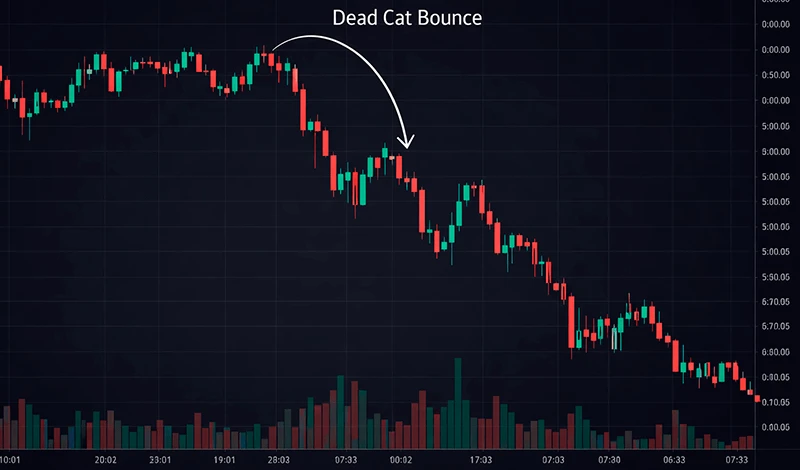
A dead cat bounce is a brief recovery in the price of an asset after a significant decline, which is followed by another drop that continues the broader downtrend.
The expression comes from the idea that even something that has fallen from a great height may briefly bounce before falling again. In financial markets, the term describes a temporary rebound that can mislead traders into believing that the worst of the decline is over.
In practice, the pattern appears after a sharp sell-off. Once prices drop rapidly, some traders begin buying the asset because they believe it has become undervalued. This buying pressure causes a short-term recovery.
However, the underlying factors that caused the initial decline are often still present. As a result, selling pressure eventually returns and pushes the price lower again.
Dead cat bounces are commonly observed during strong bearish market phases. They can occur in:
- Stock markets
- Forex currency pairs
- Cryptocurrency markets
- Commodity markets
Because the rebound can look similar to a genuine trend reversal, it may trap traders who enter long positions too early.
Understanding this concept helps traders remain cautious when markets rebound after large declines.
Difference Between a Dead Cat Bounce and a Trend Reversal
The main difference lies in the sustainability of the price movement.
A real reversal usually includes several signals such as higher lows, increasing trading volume, and improving market sentiment. A dead cat bounce, on the other hand, tends to be short and lacks structural changes in the market trend.
Traders often confirm the difference by analyzing longer-term price action and technical indicators.
Where the Pattern Commonly Appears
Dead cat bounces often appear after:
- Earnings disappointments in stock markets
- Economic news affecting currencies
- Regulatory news affecting cryptocurrencies
- Sudden macroeconomic shocks
In many cases, the initial drop is driven by strong negative sentiment. The temporary rebound occurs when short sellers close positions or when bargain hunters step in.
What Does a Dead Cat Bounce Tell You?
A dead cat bounce suggests that the overall market trend remains bearish despite a temporary price recovery.
When traders observe this pattern, it often indicates that selling pressure still dominates the market. The brief recovery may simply reflect short-term buying activity rather than a genuine shift in demand.
For market participants, this information can be useful in several ways.
Market Sentiment Remains Weak
The presence of a dead cat bounce often signals that investor confidence has not yet returned. Even though prices temporarily move higher, many traders remain cautious and continue selling during the rebound.
This behavior reinforces the broader downward trend.
Short-Term Buying Activity
Temporary rebounds often occur because:
- Short sellers close positions to lock in profits
- Traders attempt to buy at lower prices
- Algorithmic trading systems react to oversold conditions
These factors can create short-term upward pressure, but the movement is usually limited.
Potential Opportunity for Short Sellers
Some traders use the bounce itself as an opportunity to enter short positions. Instead of selling during the sharp decline, they wait for the temporary rebound to get a better entry price.
For example:
- A stock falls from 100 to 70.
- The price rebounds to 80 during a temporary recovery.
- Sellers re-enter the market.
- The price declines again toward 60.
In this situation, the bounce provides a potential entry point for traders expecting further downside.
Warning Against Early Buying
One of the main lessons of the dead cat bounce is that markets rarely move in a straight line. Even strong downtrends include temporary recoveries.
Traders who interpret every rebound as a reversal may enter positions too early and face additional losses when the downward trend resumes.
Identifying a dead-cat bounce
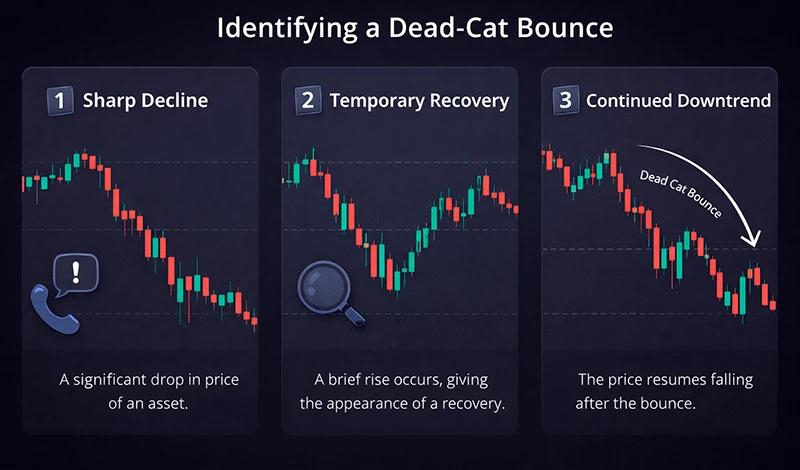
Identifying a dead cat bounce involves recognizing a temporary recovery within a strong downtrend before the price continues falling.
While no single indicator guarantees accuracy, traders typically analyze a combination of price structure, trading volume, and market context.
Step 1: Identify a Strong Initial Decline
The first stage of a dead cat bounce is a sharp downward move.
This drop usually occurs quickly and may be triggered by negative news, disappointing financial results, or broader market panic.
For example:
- A stock drops 25 percent in two trading sessions.
- A cryptocurrency loses 30 percent in a single week.
- A currency pair falls rapidly after economic data.
Such declines often create oversold conditions that can lead to a temporary rebound.
Step 2: Observe the Temporary Recovery
After the sharp drop, the price begins to rise again for a short period.
This rebound may last from a few hours to several days depending on the market. During this phase, some traders believe the asset has reached a bottom and begin buying.
However, the recovery usually lacks strong momentum.
Signs of a weak rebound include:
- Low trading volume
- Failure to break key resistance levels
- Short duration of the upward move
Step 3: Watch for the Downtrend to Resume
The final confirmation occurs when the price begins falling again.
If the price drops below the previous low, it often confirms that the rebound was temporary rather than the start of a new trend.
At this point, the bounce becomes clearly visible in the price chart.
Technical Indicators That May Help
Some traders use technical indicators to support their analysis.
Common tools include:
- Relative Strength Index (RSI)
- Moving averages
- Fibonacci retracement levels
- Volume analysis
For example, if the rebound stops near a major resistance level or moving average, it may strengthen the idea that the bounce is temporary.
However, indicators should always be used together with price action rather than as standalone signals.
Possible causes of a dead-cat bounce
A dead cat bounce can occur for several reasons related to market psychology, trading behavior, and technical factors.
Understanding these causes helps traders interpret the pattern more accurately.
Profit-Taking by Short Sellers
When traders sell an asset expecting prices to fall, they often close their positions to secure profits.
This process requires buying the asset back, which can temporarily push prices higher.
If many short sellers close positions at the same time, the resulting buying activity may create a short-term rebound.
Oversold Market Conditions
Technical indicators sometimes show that a market has fallen too quickly.
In such situations, traders may buy the asset expecting a short-term correction. This behavior can generate temporary upward momentum even if the broader trend remains negative.
Bargain Hunting
Some investors actively search for assets that have dropped significantly.
They may believe that the decline is exaggerated and that the asset offers value at lower prices.
While this buying activity can cause a rebound, it may not be strong enough to reverse the broader downtrend.
Market Psychology
Fear and uncertainty often dominate during large market declines.
When prices suddenly stabilize or move slightly higher, traders may interpret it as a signal that the worst is over.
This optimism can create a wave of short-term buying that eventually fades when negative sentiment returns.
Algorithmic Trading
Many modern markets are influenced by automated trading systems.
These systems may trigger buying orders when certain conditions are met, such as oversold indicators or technical support levels.
Although this activity can cause temporary price increases, it does not necessarily indicate a long-term change in trend.
4 Signs of a Dead Cat Bounce
Recognizing the warning signs of a dead cat bounce can help traders avoid confusing temporary recoveries with genuine trend reversals.
1. There is a gap down.
A gap down occurs when the price opens significantly lower than the previous closing price.
This usually happens after negative news or strong selling pressure outside regular trading hours.
In many cases, a gap down signals strong bearish sentiment. If a temporary rebound follows shortly afterward, it may represent a dead cat bounce rather than a real recovery.
For example, a stock may close at 80 but open the next day at 70 due to unexpected news. The sudden drop reflects aggressive selling.
If the price later rises slightly but fails to recover the previous levels, the rebound may only be temporary.
2. The security’s price steadily declines.
A prolonged downward trend is another common feature of a dead cat bounce.
Before the rebound occurs, the asset typically experiences a series of lower highs and lower lows. This pattern indicates that sellers remain in control of the market.
Even if the price briefly moves upward, the broader structure of the chart still shows a bearish trend.
Traders who analyze longer timeframes often notice that the rebound does not change the overall direction of the market.
3. The price sees a monetary gain for a short time.
The defining characteristic of the pattern is a short-term recovery.
During this phase, the price rises for a limited period. The move may appear convincing at first, especially if it occurs after a sharp decline.
However, the upward movement often lacks strong momentum. Trading volume may be low, and the price may struggle to break important resistance levels.
Because the rebound is temporary, it typically lasts only a few sessions or days.
4. A security’s price begins to regress again.
The final sign of a dead cat bounce is the return of selling pressure.
After the brief recovery, the price starts declining again. In many cases, it eventually falls below the previous low.
This renewed downward movement confirms that the rebound was not a genuine reversal.
For traders, this stage often represents the clearest confirmation that the pattern has occurred.
Limitations
Although the dead cat bounce concept is widely used in market analysis, it has several limitations.
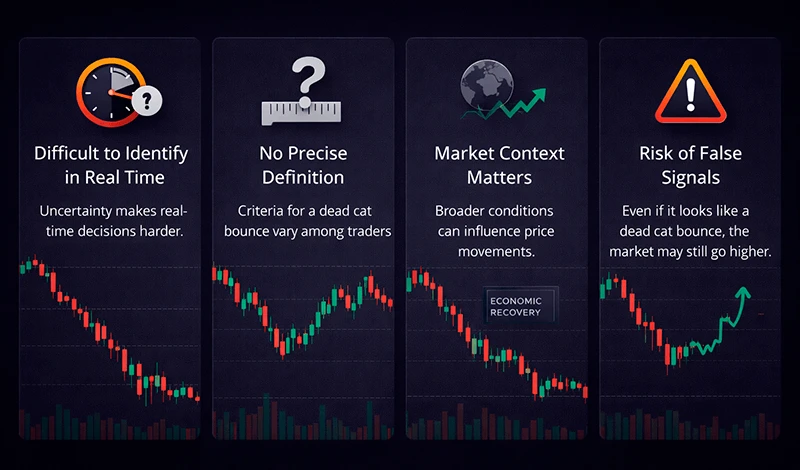
Difficult to Identify in Real Time
One of the main challenges is that the pattern is often easier to recognize after it has already occurred.
When the price begins to rebound, traders cannot immediately know whether the move represents a temporary bounce or the start of a new upward trend.
This uncertainty makes real-time decisions more difficult.
No Precise Definition
There is no universally accepted definition of how large or how long a dead cat bounce must be.
Different traders may interpret the same price movement differently depending on their strategies and timeframes.
Market Context Matters
Market conditions can influence how price movements develop.
For example, a rebound during a broader economic recovery may evolve into a genuine trend reversal rather than a temporary bounce.
Because of this, traders must consider additional factors such as:
- economic news
- company fundamentals
- overall market sentiment
Risk of False Signals
Technical patterns alone cannot guarantee accurate predictions.
Even if a rebound appears to resemble a dead cat bounce, the market may still move higher if new information changes investor sentiment.
For this reason, many traders combine pattern analysis with risk management techniques such as stop-loss orders.
Dead Cat Bounce FAQs
What does dead cat bounce mean in trading?
A dead cat bounce refers to a short-term price recovery that occurs during a broader downtrend. After a sharp decline, the asset temporarily rises before continuing its downward movement. The rebound may attract buyers who believe the market is reversing, but the recovery is usually temporary.
Why is it called a dead cat bounce?
The phrase comes from the idea that even a dead cat will bounce if it falls from a great height. In financial markets, the expression is used metaphorically to describe a brief recovery after a large price drop. The term emphasizes that the rebound does not necessarily indicate a real recovery.
How long does a dead cat bounce last?
The duration of a dead cat bounce varies depending on the market and timeframe. In some cases, it may last only a few hours or trading sessions. In other situations, the rebound may continue for several days before the downward trend resumes.
Is a dead cat bounce bullish or bearish?
A dead cat bounce is generally considered a bearish signal. Although the price temporarily rises, the broader trend remains downward. The pattern often suggests that selling pressure still dominates the market.
Can traders profit from a dead cat bounce?
Some traders attempt to profit by selling during the rebound, expecting the downtrend to continue. Others may avoid trading during the bounce to reduce risk. As with any trading strategy, outcomes depend on timing, risk management, and overall market conditions.
How can traders avoid mistaking a bounce for a real reversal?
Traders often analyze multiple factors before concluding that a trend has changed. These may include trading volume, support and resistance levels, and longer-term chart patterns. Waiting for confirmation signals can help reduce the risk of entering the market too early.
Does a dead cat bounce happen in all financial markets?
Yes, the pattern can appear in any market where prices fluctuate due to supply and demand. It has been observed in stocks, forex pairs, cryptocurrencies, and commodities. The underlying principle remains the same: a temporary recovery within a larger decline.
Meet the Author
Vanessa Polson is a marketing manager at NordFX with over twelve years of experience in online marketing within the financial services industry. She has developed and executed data-driven campaigns across search, social, and display channels in in-house environments. Her work focuses on translating complex financial products and trading tools into clear, practical educational content, giving her a broad and well-rounded view of the global trading landscape.
Connect with Vanessa on LinkedIn
戻る 戻る