Trader avec 50 $ ou 100 $ est généralement plus adapté à la pratique, aux tests de broker, ou à l'apprentissage de la psychologie du marché réel plutôt qu'à la génération de revenus significatifs. Le facteur le plus important est la taille du lot. De petites positions réduisent la probabilité de faire sauter le compte, tandis qu'un volume agressif sur des instruments volatils comme l'or, le pétrole ou les cryptomonnaies peut détruire rapidement de petits soldes.
Commencer à trader avec 50 $ ou 100 $ est possible, mais dans la plupart des cas, cela ne suffit pas pour générer des revenus sérieux à long terme. Les petits dépôts conviennent généralement mieux pour tester les conditions réelles du marché, s'entraîner à la psychologie, apprendre la gestion du risque, ou passer du trading en démo au trading réel. La principale raison pour laquelle les débutants font sauter leurs petits comptes n'est pas une mauvaise analyse du marché — ce sont des tailles de lot excessives et des attentes irréalistes. Un petit compte peut survivre à la volatilité. Une position surdimensionnée, généralement pas.
50 $ ou 100 $ suffisent-ils pour commencer à trader ?
Oui, techniquement, cela suffit pour commencer à trader.
Mais les traders doivent d'abord définir leur véritable objectif.
Il existe une différence majeure entre :
- apprendre à trader
- tester des stratégies
- s'entraîner à la psychologie
- essayer de générer des revenus sérieux
C'est là que de nombreux débutants se méprennent sur les petits comptes.
Si l'objectif est l'apprentissage, un compte démo est généralement le meilleur point de départ.
Si l'objectif est de tester les émotions liées au marché réel ou les conditions d'exécution, alors 50 $ ou 100 $ peuvent avoir du sens.
Mais si l'objectif est de générer un revenu significatif à long terme, un capital plus important est généralement nécessaire, car une gestion du risque prudente limite naturellement le potentiel de profit sur des soldes très faibles.
Quand trader avec 50 $ ou 100 $ a-t-il réellement du sens ?
Les petits comptes sont généralement utiles dans quatre situations.
Passer du démo au trading réel
De nombreux traders performent bien sur des comptes démo, mais deviennent émotifs dès que de l'argent réel entre en jeu.
Un petit compte réel peut aider les traders à :
- ressentir la peur et l'avidité
- comprendre la pression émotionnelle
- apprendre la discipline
- s'adapter à la volatilité réelle
sans risquer immédiatement un capital important.
Tester un broker
Certains traders commencent intentionnellement avec de petits dépôts pour tester :
- les retraits
- les spreads
- l'exécution
- la stabilité de la plateforme
- le traitement des ordres
avant d'engager des montants plus importants.
NordFX propose :
Cependant, le dépôt minimum ne signifie pas capital de trading recommandé. Il représente uniquement le montant minimum requis pour ouvrir et utiliser ce type de compte.
Tester des stratégies en conditions réelles
Les stratégies se comportent souvent différemment sur les marchés réels par rapport au trading en démo.
Un petit compte en argent réel peut aider les traders à évaluer :
- le slippage
- les réactions émotionnelles
- la pression liée aux positions overnight
- le comportement du spread
- l'exécution en période de volatilité
Apprendre la gestion du risque
Les petits comptes obligent les traders à respecter le dimensionnement des positions, car la marge d'erreur est très faible.
Dans de nombreux cas, cela améliore la discipline plus rapidement que de trader immédiatement de gros montants.
Pourquoi les débutants font-ils sauter leurs petits comptes si rapidement ?
Les petits comptes échouent généralement parce que les traders essaient de réaliser de gros profits trop rapidement.
Le cycle typique ressemble à ceci :
- Le trader dépose 50 $ ou 100 $.
- Les attentes de profit deviennent irréalistes.
- La taille du lot devient trop élevée.
- Un mouvement volatil entraîne de lourdes pertes.
- Le trading émotionnel commence.
- Le compte finit par être détruit.
Le marché détruit généralement les petits comptes à cause d'un volume excessif, et non d'une mauvaise analyse.
Cela est particulièrement dangereux sur :
- l'or
- le pétrole
- les CFD sur cryptomonnaies
car la volatilité peut amplifier les pertes extrêmement rapidement.
Quel est l'élément le plus important pour un petit compte ?
L'élément le plus important est la taille du lot.
La taille du lot détermine le montant gagné ou perdu lorsque le marché évolue.
Pour les débutants utilisant de petits soldes, un volume minimal est généralement essentiel.
Dans de nombreux cas :
- une taille de lot de 0,01 = exposition gérable
- des positions plus importantes = risque nettement plus élevé
C'est pourquoi de nombreux traders expérimentés disent : « La survie passe avant tout. Le profit vient ensuite. »
Pourquoi une position légèrement plus importante peut-elle devenir dangereuse ?
De nombreux débutants sous-estiment à quel point la taille de la position modifie l'exposition du compte.
Même une augmentation modeste du volume peut considérablement accroître le risque.
Par exemple :
- un trader ouvre des positions sur le pétrole avec un volume prudent
- les profits semblent d'abord stables
- la taille de la position est légèrement augmentée
- la volatilité amplifie soudainement les pertes bien plus vite que prévu
Le pétrole, l'or et les cryptomonnaies peuvent évoluer de manière agressive en quelques minutes.
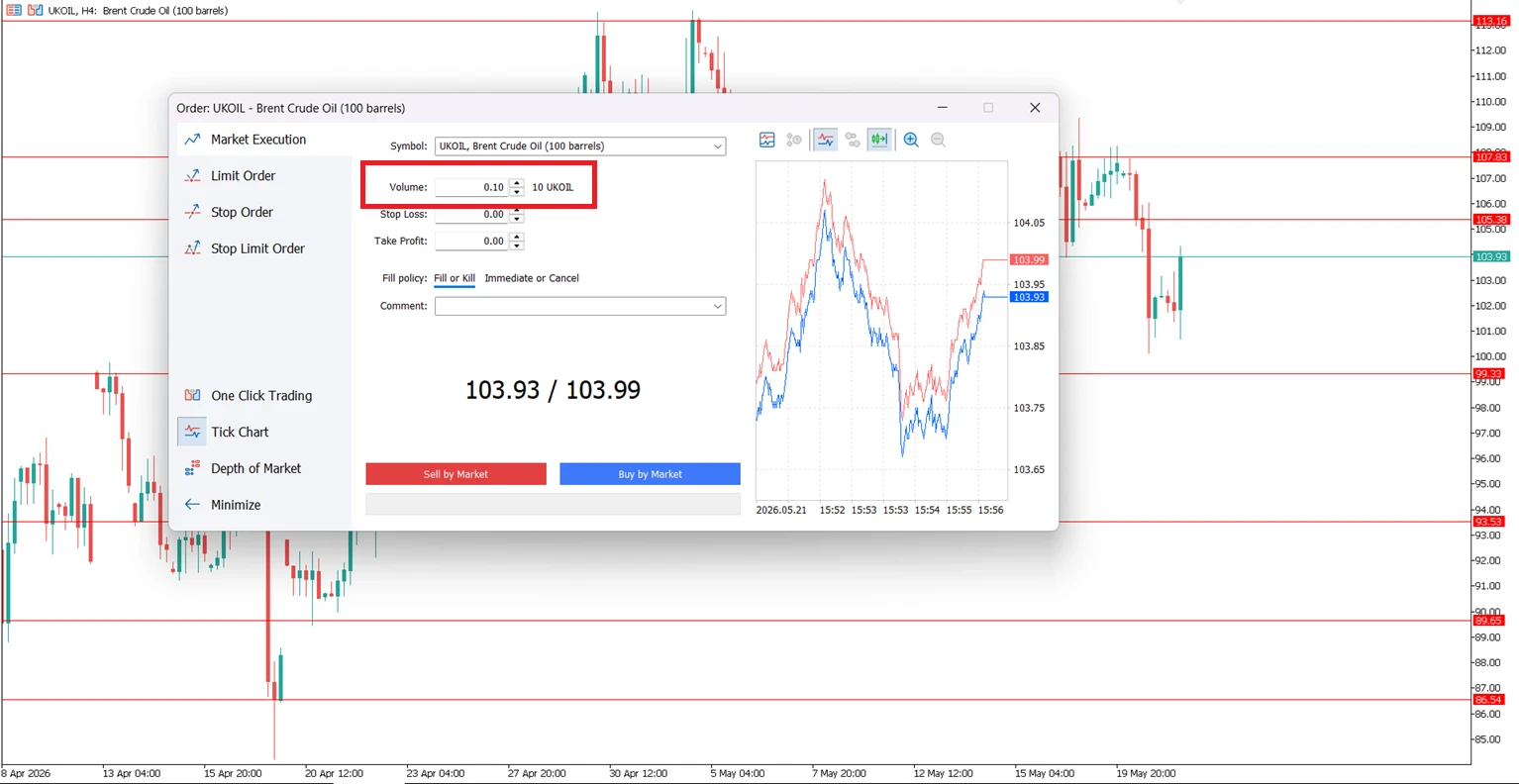
Une transaction qui semble gérable avec un lot de 0,01 peut devenir source de stress émotionnel avec un volume plus important, car la volatilité peut accélérer les pertes très rapidement.
C'est l'une des principales raisons pour lesquelles les débutants font sauter leur compte après quelques transactions réussies.
Quels instruments sont plus sûrs pour les débutants ?
Aucun marché n'est totalement sûr.
Cependant, certains instruments sont généralement plus faciles à gérer pour les débutants, car leur volatilité est plus stable.
Instrument | Difficulté pour débutant | Pourquoi |
EUR/USD | Plus faible | Mouvement généralement plus stable |
USD/JPY | Plus faible | Volatilité souvent plus régulière |
Or (XAU/USD) | Moyenne à élevée | Fortes réactions aux actualités macroéconomiques |
USOIL | Élevée | Pics de volatilité agressifs |
CFD sur cryptomonnaies | Très élevée | Mouvements importants et imprévisibles |
De nombreux débutants commencent avec :
- EUR/USD
- USD/JPY
avant de passer à des instruments plus volatils comme l'or, le pétrole ou les cryptomonnaies.
Lecture connexe :
Comment la taille du lot influence-t-elle le risque sur un compte de 100 $ ?
Les petits comptes sont très sensibles aux variations de volume.
Instrument | Taille du lot | Niveau de risque pour les débutants |
EUR/USD | 0,01 | Généralement gérable |
Or (XAU/USD) | 0,01 | Risque de volatilité plus élevé |
USOIL | 0,01 | Peut tout de même évoluer de manière agressive |
BTCUSD | 0,01 | Exposition à une forte volatilité |
C'est pourquoi les débutants devraient se concentrer davantage sur le contrôle de l'exposition que sur des profits rapides.
Un risque plus faible signifie généralement une croissance plus lente.
Un risque plus élevé signifie généralement une destruction plus rapide du compte.
Comment un débutant peut-il trader plus prudemment sur MT5 ?
Un débutant utilisant MT5 peut réduire le risque en suivant une structure très simple.
Exemple de méthode plus sûre pour un débutant
- Ouvrir MT5.
- Choisir un instrument relativement stable comme l'EUR/USD.
- Sélectionner un volume minimal, par exemple 0,01 lot.
- Définir un stop-loss avant d'ouvrir la position.
- Éviter d'ouvrir plusieurs positions simultanément.
- Ne pas augmenter le volume après une transaction réussie.
Cette approche génère généralement des profits plus modestes.
Mais elle réduit également fortement la probabilité de faire sauter le compte rapidement.
Pour des tutoriels sur la plateforme :
Dépôt minimum vs capital de trading réaliste
C'est l'un des aspects les plus mal compris du trading.
Type de compte ou objectif | Montant | Signification pratique |
Dépôt minimum MT5 Pro | 50 $ | Accès au trading réel de niveau débutant |
Dépôt minimum MT5 Zero | 100 $ | Accès aux conditions du compte Zero |
Compte démo | Fonds virtuels | Préférable pour les débutants complets |
Capital de trading plus important | 500 $ et plus | Généralement plus réaliste pour le trading à long terme |
Un dépôt minimum n'équivaut pas à un capital de trading recommandé.
De nombreux débutants confondent ces deux notions.
Pourquoi la psychologie est-elle si dangereuse pour les petits comptes ?
Le plus grand danger des petits comptes est souvent la pression psychologique.
Des tailles de lot prudentes génèrent généralement de faibles profits.
Cela crée de la frustration.
De nombreux traders alors :
- augmentent agressivement le volume
- surtradent
- font du revenge trading après des pertes
- abandonnent la gestion du risque
Le désir émotionnel de faire croître rapidement le compte devient souvent plus dangereux que le marché lui-même.
Erreurs courantes qui font sauter les petits comptes
Problème | Raison | Comment l'éviter |
Vouloir s'enrichir rapidement | Attentes irréalistes | Considérer les petits comptes comme un capital éducatif |
Utiliser des tailles de lot importantes | Avidité et impatience | Utiliser un volume minimal |
Trader l'or de manière agressive | Forte volatilité | Commencer par des paires évoluant plus lentement |
Augmenter le volume après des profits | Excès de confiance | Maintenir un risque constant |
Surtrading | Pression émotionnelle | Trader moins de configurations |
Ignorer le stop-loss | Espérer que le marché s'inverse | Définir le risque avant l'entrée |
La vérité réaliste sur les petits comptes
Les petits comptes peuvent être utiles.
Mais surtout pour :
- apprendre
- tester
- la transition émotionnelle
- comprendre le comportement du marché réel
Essayer de générer un revenu important à partir d'un capital très faible pousse généralement les traders vers un risque excessif.
Et c'est ce risque excessif qui détruit la plupart des comptes débutants.
L'objectif d'un petit compte devrait généralement être la survie et l'expérience avant tout — et non des attentes de profit agressives.
FAQ
Peut-on gagner de l'argent en tradant avec 50 $ ?
Oui, mais les profits resteront généralement limités, sauf si le risque devient agressif.
Pourquoi les débutants font-ils sauter leurs comptes si rapidement ?
Généralement à cause de positions surdimensionnées et d'attentes de profit irréalistes.
Une taille de lot de 0,01 est-elle plus sûre pour les débutants ?
Dans de nombreux cas, oui. Des positions plus petites réduisent l'exposition et aident les traders à survivre à la volatilité.
Pourquoi l'or et le pétrole sont-ils risqués pour les débutants ?
Parce que la volatilité peut amplifier les pertes très rapidement, en particulier sur les petits comptes.
Le trading en démo est-il préférable au trading avec 50 $ ?
Pour les débutants complets, généralement oui.
L'effet de levier détruit-il automatiquement les comptes ?
Non. Les positions surdimensionnées et une mauvaise gestion du risque sont généralement le véritable problème.
100 $ suffisent-ils pour un revenu de trading professionnel ?
Dans la plupart des cas, non. Un capital plus important est généralement nécessaire pour un revenu significatif à long terme.
Cet article est fourni à titre éducatif uniquement et ne doit pas être considéré comme un conseil en investissement ou en trading.
À propos de l'auteure
Vanessa Polson est responsable marketing chez NordFX et possède plus de douze ans d'expérience dans le marketing en ligne au sein du secteur des services financiers. Elle a conçu et mis en œuvre des campagnes basées sur les données sur les canaux de recherche, sociaux et display, au sein d'équipes internes. Son travail consiste à transformer des produits financiers complexes et des outils de trading en contenu éducatif clair et pratique, ce qui lui confère une vision large et complète du paysage mondial du trading.
Connectez-vous avec Vanessa sur LinkedIn.
Revenir en arrière Revenir en arrière