Short answer
A social trading broker is a broker that allows traders to follow, evaluate, and automatically copy the trades of other traders. In simple terms, one trader shares a strategy, while another trader subscribes to it and lets matching trades be placed in their own account. A strong social trading broker does much more than offer copying alone. It should also provide transparent performance statistics, risk data, ranking tools, and enough control for users to manage or stop subscriptions when needed.
This model is popular because it can shorten the learning curve for beginners and create an additional income stream for experienced traders. However, social trading is not a passive shortcut to guaranteed profit. Results still depend on the quality of the provider, the level of risk being taken, and the subscriber’s ability to choose wisely.

What is a social trading broker?
A social trading broker combines brokerage services with a built-in environment where traders can publish strategies, attract followers, and allow others to copy their trades. The broker provides the trading account and execution infrastructure, while the social trading system gives users access to provider profiles, statistics, rankings, and subscription settings.
This distinction matters because many traders confuse the broker with the social trading interface itself. The broker is the service provider. The social trading system is the tool inside that broker’s environment. When these two parts work well together, users can discover traders, compare performance, review risk, and activate copying without leaving the broker’s ecosystem.
The two sides of the model
A social trading broker usually serves two groups of users. The first group is experienced traders who want to share their strategy and earn from it. These users act as signal providers. The second group is traders who want to follow and copy those strategies. These users act as signal subscribers.
For providers, the system offers visibility and the opportunity to earn performance-based fees. For subscribers, it offers access to real strategies without having to build everything from scratch. This is one of the main reasons social trading has become attractive to beginners, busy traders, and users who prefer a more guided approach.
What makes a broker suitable for social trading
Not every broker offering copying tools is equally useful. A strong social trading broker should help users make better decisions before they subscribe. That means showing more than headline returns. Traders need to see track record length, consistency, risk level, drawdown, and the general behavior of the strategy.
A good system should also make it easy to compare providers, understand the fee model, and stay in control of the account. Social trading works best when the subscriber is not just following a leaderboard, but reviewing a clear set of metrics before making a decision.
How social trading works
The process is usually straightforward. A provider joins the system, connects a trading account, and publishes an offer. A subscriber then reviews the available providers, compares their results and conditions, and chooses one to follow. Once the subscription is activated, eligible trades from the provider are copied automatically into the subscriber’s account according to the selected parameters.
Although the process sounds simple, the real value lies in the details. Subscribers should not only look at returns. They should also check whether the strategy has been stable over time, whether the risk level fits their own tolerance, and whether the fee structure makes sense.
How it works for providers
For providers, social trading starts with registering a trading account in the system and making it available to followers. They usually complete a profile, define an offer, and allow subscribers to review their performance. Their goal is not only to trade well, but also to build trust through consistency and reasonable risk management.
A provider with one impressive month is not always a strong provider. In social trading, long-term behavior matters much more than short-term spikes. Subscribers typically look for stability, discipline, and a risk profile they can live with.
How it works for subscribers
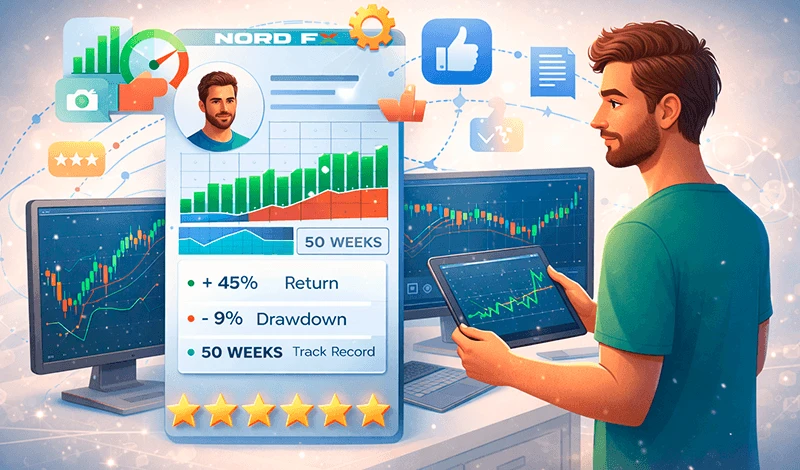
For subscribers, the process begins with choosing a provider. This is the most important step. The subscriber should compare available traders, review their history, check how aggressive or conservative the strategy looks, and only then activate copying.
Once the subscription is live, trades are mirrored automatically in the subscriber’s account. However, that does not mean the subscriber can ignore the account completely. Social trading still requires monitoring. A subscriber should review results regularly, watch for changes in behavior, and be ready to stop copying if the strategy no longer fits their goals.
How fees are usually structured
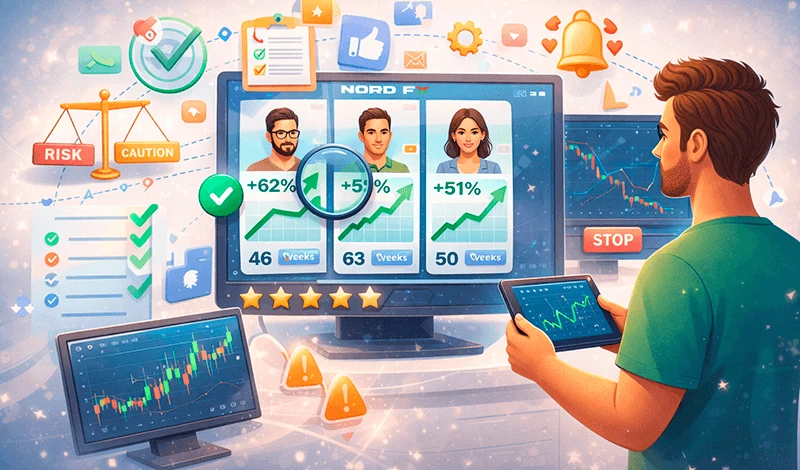
Many social trading systems use a performance-based model. This means the provider earns when the subscriber earns. This structure is appealing because it creates a clearer alignment of interests than a flat subscription fee alone.
Even so, the fee model should always be reviewed carefully. Traders need to understand what they are paying for, when fees are charged, and whether the conditions still make sense after trading costs and risk are considered. A social trading broker should make this transparent from the start.
Social trading vs copy trading vs signals
These three terms are often used as if they mean the same thing, but they are not identical. Copy trading is the narrowest concept. It usually means the automatic replication of another trader’s positions in your own account. Social trading is broader. It often includes copy trading, but also adds rankings, provider discovery, performance data, and decision-making tools. Signals are different again. A signal may simply be an alert or trade idea that the user receives and then chooses to act on manually.
In other words, copy trading is usually the execution mechanism, social trading is the broader environment around it, and signals are pieces of information that may or may not lead to a trade.
Why the difference matters
This distinction matters because a trader searching for a social trading broker is usually looking for more than raw trade alerts. They are typically looking for a complete system where they can discover traders, compare statistics, assess risk, and copy positions within one broker environment.
That is why social trading has stronger decision-making intent than signals alone. A user searching for signals may only want ideas. A user searching for a social trading broker is much closer to choosing a service.
Model | Main idea | How trades happen | What the user mainly does |
Social trading | A broker-based environment for finding, evaluating, and following traders | Usually automatic after subscription | Compare providers, review metrics, choose who to follow |
Copy trading | Automatic mirroring of another trader’s positions | Automatic | Select a trader and allow trades to be replicated |
Signals | Trade ideas or alerts from a trader or service | Often manual | Receive information and decide whether to place the trade |
Which model suits which trader
Social trading is usually better for traders who want both automation and context. Copy trading suits those who mainly want straightforward replication. Signals are more suitable for traders who still want to make the final execution decision themselves.
For beginners, social trading is often the most practical starting point because it combines access to experienced traders with the ability to review performance data before subscribing. For more independent traders, signals may feel more flexible. The right choice depends on how much control, automation, and guidance the trader wants.
Why traders use social trading
Traders use social trading because it reduces friction between wanting to trade and knowing how to trade well. Instead of building a full strategy from zero, a subscriber can study available providers, compare their results, and follow a strategy that already has a visible track record. This makes social trading especially attractive to beginners, busy professionals, and traders who prefer a more structured starting point.
Another reason social trading has become popular is that it creates value for both sides of the market. Subscribers get access to strategies they may not be able to build on their own yet. Providers get a chance to earn additional income by sharing their trading activity with followers. A good social trading broker makes this relationship transparent, so both sides understand the rules, the fees, and the level of risk involved.
A faster starting point for beginners
For many beginners, the hardest part of trading is not opening an account. It is knowing what to trade, when to enter, how much risk to take, and when to exit. Social trading simplifies this stage. Instead of guessing, the subscriber can review real traders and choose a provider whose style appears more disciplined and understandable.
That does not remove the need to learn. But it can make the early stage less chaotic. In practice, social trading gives beginners a way to observe real-world execution, understand how different traders behave, and gain market exposure without having to invent a complete strategy immediately.
A practical solution for busy traders
Not every trader has time to watch the market all day. Some users want market exposure but do not want to spend hours analyzing charts, news, and entry levels. Social trading can help in that situation because it allows the subscriber to delegate part of the execution process to a selected provider.
This is one of the reasons the keyword social trading broker has such strong commercial intent. People searching for it are often not just researching theory. They are looking for a broker that offers a more efficient way to participate in the market while still keeping account ownership and control on their side.
An extra income stream for experienced traders
For providers, social trading can turn trading skill into an additional revenue stream. If a trader builds a consistent track record and attracts followers, their strategy becomes more than a private activity. It becomes a monetizable service inside the broker environment.
This is important because social trading is not only about subscribers copying trades. It is also about providers building credibility. The strongest providers usually understand that consistency, disciplined risk, and trust matter more than one short burst of performance.
Access to different styles and diversification
Social trading also attracts users because it opens the door to different trading styles. One provider may focus on shorter-term momentum. Another may prefer slower trend-following setups. Another may be more conservative. For the subscriber, this creates the possibility of diversification, not only across instruments, but across trading behavior.
That said, diversification in social trading only works when it is done with intention. Following several providers without understanding how similar their strategies are can create hidden concentration instead of real diversification. A good social trading broker should help users see those differences more clearly through transparent metrics and performance history.
Risks of social trading
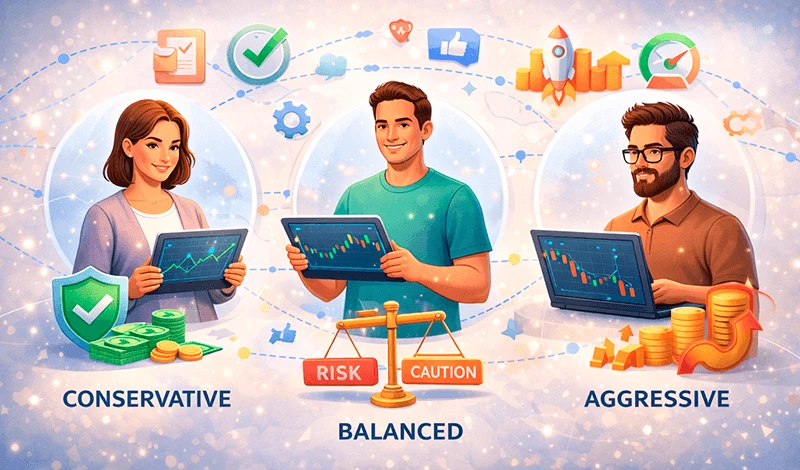
The biggest mistake people make with social trading is assuming that automation removes risk. It does not. Social trading can simplify execution, but it does not protect the subscriber from poor provider selection, excessive risk-taking, weak discipline, or sudden strategy changes. The risk is not gone. It is simply transferred into a different part of the decision-making process.
This is why the best social trading articles do not stop at “how it works.” They also explain what can go wrong. If a trader chooses a provider based only on recent profit, ignores drawdown, or treats the subscription like passive income, the outcome can be disappointing very quickly.
Chasing high returns without checking risk
The most common error is choosing the trader with the highest return and assuming that more profit means more skill. In reality, very high short-term returns often come from very aggressive position sizing, weak loss control, or concentrated exposure. A provider may look impressive on a leaderboard while taking risks that many subscribers would never accept knowingly.
This is why return should never be viewed in isolation. A social trading broker should help users compare profit together with drawdown, consistency, duration, and risk behavior. Without that context, headline performance can be misleading.
Confusing a short history with proven ability
A provider who made strong returns over a few weeks or a month may simply be benefiting from a favorable market phase. That is not the same as a robust strategy. A short track record can hide instability because it has not been tested across enough conditions.
Subscribers should be careful with providers whose performance looks spectacular but whose history is too short to evaluate properly. In most cases, a longer and steadier record is more meaningful than one brief period of explosive growth.
Ignoring drawdown
Drawdown is one of the most important risk indicators in social trading, yet many beginners ignore it. A provider may recover losses later and still show attractive returns, but that does not change the fact that the subscriber had to survive the decline first. For many users, the real problem is not whether a strategy eventually recovers. It is whether they can tolerate the fall along the way.
This is why drawdown matters so much when choosing a social trading broker and when evaluating signal providers. A broker that makes drawdown easy to see is far more useful than one that only promotes profit percentages.
Blindly trusting automation
Automation is convenient, but convenience can create passivity. Some subscribers activate copying and stop monitoring the account altogether. That is risky. Providers can change behavior. Market conditions can shift. A strategy that worked in one environment may start underperforming in another.
Social trading still requires supervision. The subscriber does not need to place every trade manually, but they do need to review performance, compare the current behavior with the original profile, and decide whether the strategy still deserves trust.
Following too many providers without a plan
At first glance, following many providers can look like a safe approach. In reality, it often creates confusion. If the providers are all using similar instruments or a similar style, the subscriber may end up multiplying the same risk instead of diversifying it.
A better approach is to build a clear framework first. Know why each provider is in the portfolio, what role they play, how much capital they receive, and what warning signs would justify stopping the subscription.
How to choose a social trading broker
Choosing a social trading broker is not only about finding a broker that offers copying. It is about finding a broker that makes provider selection more transparent, risk easier to evaluate, and account control easier to maintain. The right broker should help users think better, not just act faster.
A weak social trading broker tends to emphasize convenience alone. A strong one gives users enough information to make selective, rational decisions. That difference is critical because the quality of the broker environment directly affects the quality of provider selection.
Look for transparency first
A reliable social trading broker should show more than provider names and headline profit. The platform should display performance history, track record length, drawdown, activity level, and ranking logic clearly. Users should not have to guess how a provider reached a result.
Transparency also applies to fees. The broker should make it clear how providers are compensated, when fees are charged, and what other trading costs may affect the final outcome. If the fee structure is difficult to understand, that is already a warning sign.
Check whether the broker supports real evaluation
The best social trading broker is not the one with the flashiest leaderboard. It is the one that helps subscribers evaluate providers in a disciplined way. That means filters, sorting tools, track record visibility, and enough data to compare one provider against another.
A strong evaluation environment also helps reduce emotional decision-making. Instead of chasing the biggest number, the subscriber can review several factors at once and choose a provider whose profile actually matches their goals.
Make sure the system keeps you in control
A social trading system should automate trade copying, but it should not remove control from the subscriber. Users should be able to start, pause, stop, or adjust subscriptions without unnecessary friction. They should also understand where the money sits, how positions are being copied, and what happens if they want to change providers.
Control matters because social trading is still your account and your capital. The provider influences the trades, but the responsibility for choosing and continuing that relationship remains with the subscriber.
What metrics matter when evaluating signal providers
When evaluating signal providers, the goal is not to find the most exciting profile. It is to find the most suitable one. A suitable provider is not necessarily the one with the highest return. It is the one whose results, risk behavior, and trading style fit the subscriber’s expectations and tolerance.
This is where many beginners make avoidable mistakes. They look at profit first and everything else second. A better process is to begin with stability and risk, then move to returns. If the foundation is weak, strong profits do not mean much.
Return
Return matters, but it should be read with context. A high return can be impressive, but it should always be compared with the amount of risk taken to achieve it. A provider who delivers moderate but steady growth may be more suitable than one who posts dramatic gains followed by sharp declines.
Drawdown
Drawdown shows how much the strategy has fallen from its previous high point. This is one of the clearest ways to understand the pain a subscriber may experience while following a provider. A strategy with a large drawdown may still end in profit, but it can be psychologically and financially difficult to hold through that period.
Track record length
A longer record makes evaluation more reliable. A provider with only a short history may not have faced enough market conditions to prove that the strategy is durable. Time helps reveal whether performance is based on repeatable behavior or short-lived momentum.
Consistency
Consistency is often a stronger sign of quality than raw return. A provider whose results are relatively stable over time is usually easier to trust than one whose performance is highly erratic. Consistency does not mean every month must be profitable. It means the overall behavior looks disciplined rather than chaotic.
Trading style and activity
Subscribers should understand whether a provider trades frequently or selectively, whether positions are usually short-term or longer-term, and whether the style fits the subscriber’s expectations. A mismatch here can lead to frustration even if the provider is profitable. For example, a very aggressive style may be unsuitable for a subscriber who prefers lower stress and smoother performance.
Risk concentration
It is important to see whether a provider depends too heavily on one instrument, one market condition, or one type of setup. Concentration can produce strong gains when conditions are favorable, but it can also create vulnerability when the environment changes.
Metric | What it shows | Why it matters |
Return | Total growth over a period | Helps measure performance, but should never be viewed alone |
Drawdown | Size of decline from a previous high | Shows the level of risk and pressure a subscriber may face |
Track record length | How long the strategy has been active | Helps judge whether performance is proven or still too new |
Consistency | Stability of results over time | Suggests whether the strategy is disciplined or erratic |
Trading style | How the provider trades | Helps determine whether the strategy suits the subscriber |
Risk concentration | Dependence on a narrow approach | Reveals whether the strategy may be too exposed to one condition |
The best way to evaluate a signal provider is to read these metrics together, not separately. A provider with strong return, low consistency, short history, and deep drawdown may be far less attractive than a provider with moderate return, longer history, and steadier behavior. This is exactly why choosing a social trading broker is so important.
Who social trading is best for
Social trading is best for traders who want market access with more structure and less guesswork. It is especially suitable for beginners who are still learning how strategies behave in real conditions, for busy users who do not have time to monitor the market all day, and for experienced traders who want to turn their track record into an extra income stream by offering signals to others.
Beginners who want a guided start
For beginners, social trading can reduce the pressure of making every decision alone from the first day. Instead of building a full strategy immediately, they can review providers, compare performance, and observe how real traders manage positions over time. That does not remove the need to learn, but it can make the first stage more practical and less chaotic.
Traders with limited time
Some traders want exposure to the market but do not have the schedule to analyze every setup themselves. For this group, social trading can be appealing because it automates execution once a provider is selected. The key point, however, is that time-saving should not be confused with risk-free investing. Automation can reduce workload, but it does not remove the need for oversight and review.
Experienced traders who want to monetize skill
Social trading is also a good fit for traders who already have a strategy and want to earn beyond their own account performance. Providers can publish offers, build a following, and receive performance-based compensation. This creates an incentive to build not just profit, but credibility and consistency.
Traders who value comparison and selection tools
Social trading suits traders who want more than raw alerts. It is particularly useful for people who want to compare traders through visible statistics, risk data, and performance history before making a decision. That makes the model more structured than simply following trade ideas blindly.
How NordFX approaches social trading
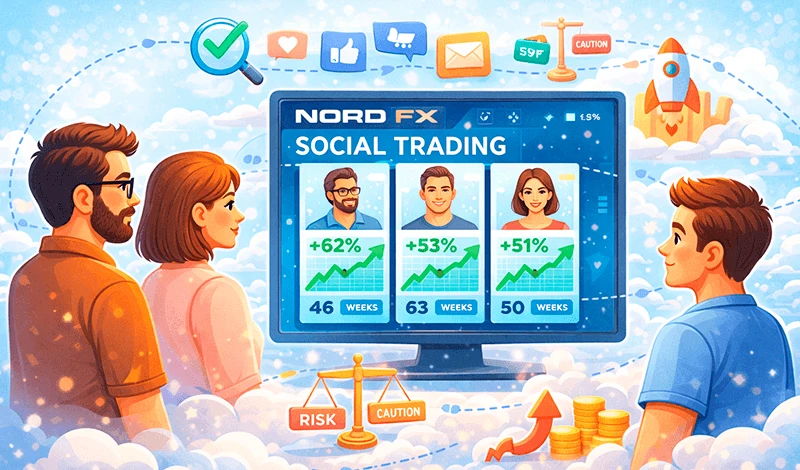
NordFX approaches social trading as a broker-based system built around two core roles: the Signal Provider and the Signal Subscriber. The provider is the trader whose transactions can be copied by others for a reward. The subscriber is the trader whose account automatically copies those transactions online. This creates a simple structure: one side offers a strategy, and the other side chooses whether to follow it.
A provider-subscriber model with clear mechanics
The process is straightforward. Providers can open a new account or use an existing one, register it in the Social Trading system, create an offer, and trade with the goal of attracting subscribers. Subscribers open and fund an account, register in the same system, choose a provider from the rating, review the offer, and activate the subscription.
Emphasis on monitoring and selection
A strong point in the NordFX model is the focus on measurable provider evaluation. The company states that users can monitor each signal provider through more than 50 parameters. Subscribers can also view the provider’s position in the rating and the number of investors already signed up. This helps move the decision away from emotion and closer to visible data.
Control remains with the subscriber
One of the most important practical features is account control. Subscribers do not need to transfer funds to the provider, because the money remains in the subscriber’s own account. The subscriber can also stop or suspend copying at any time, set parameters, and add or withdraw funds. This is an important trust point because users usually feel more comfortable when they understand that copying does not mean giving up direct control over their capital.
Performance-based cost logic
NordFX also highlights a performance-based payment model. According to the page, the subscriber pays the supplier a percentage of profit starting from 10%, built around the logic of “No profit, no payment.” The page also says the minimum initial deposit is around $100 on average, depending on the provider’s offer. This makes the service more accessible while keeping the fee model tied to results.
Automation with flexibility
The service is designed to be automated but adjustable. NordFX states that copying continues even when the terminal and computer are turned off, and the FAQ notes that users can create up to 100 subscriptions or 100 offers per account. This shows that the model is built not just for convenience, but also for flexibility and scale.
Final thoughts
A social trading broker should not be judged only by how easy it is to copy trades. The more important question is whether the broker helps users choose providers intelligently, understand risk clearly, and remain in control of their own account. That is what separates a serious social trading environment from a simple ranking page with attractive numbers.
NordFX fits this topic best when it is presented not as a promise of easy profit, but as a broker-based system where traders can compare providers, review monitored statistics, choose offers, and automate copying while still keeping control over their funds and settings.
FAQ
What is a social trading broker?
A social trading broker is a broker that allows traders to follow, evaluate, and copy the trades of other traders within the broker’s own environment. A strong social trading broker usually combines account infrastructure, provider rankings, performance tracking, and subscription tools in one place.
Is social trading suitable for beginners?
It can be suitable for beginners because it reduces the need to build a full strategy from zero on day one. However, beginners still need to assess providers carefully, understand drawdown and risk, and avoid treating the service as passive income.
What is the difference between social trading and copy trading?
Copy trading usually refers to the automatic replication of another trader’s positions. Social trading is broader and often includes provider discovery, rankings, performance data, and evaluation tools around that copying process. Signals are different again, because they often require the user to place trades manually.
What should a social trading broker provide?
A strong social trading broker should provide transparent performance history, useful risk indicators, track record visibility, easy provider comparison, and a simple way to activate or stop copying.
What metrics matter most when evaluating signal providers?
The most important metrics are return, drawdown, track record length, consistency, and overall risk behavior. Profit alone is not enough. A provider with moderate but steady performance and controlled drawdown may be more reliable than one with very high short-term returns driven by aggressive risk.
How does NordFX social trading work?
NordFX uses a provider-subscriber structure. Providers register an account, create offers, and share their trading activity. Subscribers register an account, review providers from the rating, choose an offer, and activate copying. The company also states that provider results are monitored across more than 50 parameters.
Do subscribers keep control of their funds with NordFX?
Yes. According to the NordFX social trading page, subscribers do not transfer funds to the provider. The funds remain in the subscriber’s own account, and the subscriber can stop or suspend copying, adjust parameters, and add or withdraw funds.
Meet the Author
Vanessa Polson is a marketing manager at NordFX with over twelve years of experience in online marketing within the financial services industry. She has developed and executed data-driven campaigns across search, social, and display channels in in-house environments. Her work focuses on translating complex financial products and trading tools into clear, practical educational content, giving her a broad and well-rounded view of the global trading landscape.
Connect with Vanessa on LinkedIn.
Revenir en arrière Revenir en arrière